Monday, March 7, 2016

Learning the reality of the physics of thermonuclear devices and beyond


Today I will try to explain in simple, everyday terms how I learned what really goes on at the nuclear level in “low to moderate energy systems” like thermonuclear explosions. This may sound like a dangerous subject for an open (though obscure blog), but for me it is actually a break from things which I view as far riskier. Just an instructive romp through the realities of science life today, and of what we know about the universe. Yes, it involves thermonuclear devices in a very practical way, but if you think H-bombs are scary, you have no idea what else is on the horizon today in ever so many directions! (Yes, the H bombs still could kill us all, but that’s more a story about politics than about physics at this point.)

Last week, I gave a heavy, dense seminar to pure mathematicians on the current status of our effort to understand how the universe really works. It was such a pleasure to go back and speak in my native language, mathematics... but don’t worry, I won’t inflict that on you here (though maybe I will post those slides somewhere at some point). Instead, I will tell some stories... which came up during the seminar...

Mainly I will tell the story of how my thoughts and my life were changed by reading a book called The Skyrme Model, by Makhankov, Rybakov and Sanyuk (MRS), which came out from Springer in 1994. The yellow book... At that time, I had some other connections through to the Joint Institute for Nuclear Research in Russia (JINR, Dubna), the “Los Alamos of Russia,” where Makhankov was a division director, but I will spare you the distraction for now (sigh). That yellow book was a huge turning point for me, in many many ways.

MRS was the hardest book to read and understand which I ever read in my entire life, and that’s saying a lot. A whole lot. On the first day I started reading it, I went to bed deeply and vastly discouraged. “I imagined I could make some contribution here, in developing the mathematics to explain what protons and neutrons really are, but as I read this book, it looks as if I won’t even be able to understand what has ALREADY been done in Russia on that subject.” But about 3AM that night, in my bedroom in College Park, I engaged in my usual nightly practice of “cosmic consciousness” or “conversations with God” or “posthuman state” or whatever you may call it. (At this moment, I am almost finished reading a sci fi, Count to a Trillion, by John Wright, which uses that last term... familiar issues... ). In that state, I saw an image of what MRS **MIGHT** be talking about. The next day, I cross-checked, and yes, it was exactly like that theory! MRS were not like mathematicians, proceeding from axioms through logic to predictions or theorems...  but by doing it right in my own mind, I could get to the same place. Finally, after three or four really intense days, I was able to disentangle it, and see further than the authors on some important aspects.  I don’t remember ALL of what is in that book....but what I do remember is important enough.

Some parts of the book were easy to understand. I will simplify a little... and laugh to myself at the idea you might try to read it yourself. Please read the cautionary tales first if you do...  

“We in Russia, like physicists in America, will of course begin our sacred proceedings with a prayer to that great God in the sky, Quantum Chromodynamics (QCD)...”

In case you don’t know about QCD, here is a quick summary. You probably know already that human science knows about five types of basic force in the universe – electric force, magnetism, weak nuclear force, strong nuclear force and gravity. By the start of the twentieth century, even before quantum mechanics was developed, physicists learned that electric force and magnetic force are really just two sides of the same force, electromagnetism. (Can’t I display just one iddy-bitty covariant vector field here? No, I promised everyday language.) Weak nuclear force is basically what comes out when radioactive material decays to a lower state; over time, that radiation can kill you, but it’s not explosive. Strong nuclear force is what holds the nucleus of an atom together, and also what propels an H-bomb. In the 1950s, three people (one of them Schwinger, one of my teachers at Harvard) got the Nobel Prize for developing Canonical Quantum Electrodynamics (QED or KQED), which is the modern quantum mechanical theory of how electromagnetism works. QED is the real workhorse of the electronics and photonics industries. But now, we recognize that QED is just a useful approximation, like Newton’s theory of how gravity works. NASA still uses Newton’s theory to predict the orbits of planets and spacecraft, and industry still uses QED, but we know that those theories are not the exact truth. Mainstream physicists today talk a lot about the current “standard model of physics,” which is a pasting together of two quantum field theories: (1) Electroweak Theory (EWT), which is an extension of QED to predict weak nuclear force and electromagnetism, in a unified way; and (2) QCD, the “second quark theory,” due to Gellman, used to describe strong nuclear forces. There is a lot of debate about how to paste together or unify the standard model of physics with gravity, which seems to be well-described by Einstein’s theory of general relativity (GR), but GR is not a quantum mechanical theory.

MRS: “We know that QCD works very well in predicting what happens at very high energies, like two particles colliding at enormous energies in big accelerators, but because it is so complicated it cannot be used to predict what happens at low to medium energies. ‘Low to medium energies’ includes thermonuclear devices like what we develop here in Dubna, and so we cannot expect this great god in the sky to come and help us. In the real and humble engineering task of making predictions for what happens in humble experiments here in this lowly real world, beneath the level of lofty metaphysicists, we therefore use what they call ‘phenomenological models.’ We in Russia have less faith in the invisible gods than people in the West do, but really, that is not so important, since ‘phenomenological models’ are what we use for prediction of experiment anyway. “

“We are amused that interest in the Skyrme model (a phenomenological model of what a proton or neutron is) was very low in universities in the West, because of its religious incorrectness, until someone showed that the Skyrme model is equivalent to QCD in the limit where 3 equals infinity; this made it possible to call it an approximation to QCD, and discussable ... to a limited degree.”

Maybe here I should say more about just how important “phenomenological models” are to nuclear technology. In some fields of technology, like drug development or battery development,  people have gotten away with mindless trial-and-error approaches on a huge scale. Try out a thousand possible drugs in the laboratory, and just see what happens. Computer simulation can help in those fields, but thousands and thousands of experiments are still used. (This reminds me of how China is far ahead of the US in battery development for now, but far behind in some other fields, like access to space, where a more analytic approach is needed.) But with nuclear weapons, trying out a few thousand designs without knowing what to expect is not such a good idea! For this reason, computer simulations have always played a very central role in nuclear technology development, civilian and military, in US and Russia (the two nations I know the most about on this subject). But what kind of model actually gets used in these computer simulations, to make predictions? Not QCD. The accuracy of phenomenological models is in fact crucial to the development of nuclear technology! It is not a coincidence that the biggest supercomputers in the US have been at two nuclear labs, Lawrence Livermore and Oak Ridge. My very first tenured job, at DOE, involved oversight of some of the computer codes at Oak Ridge. (I still remember my boss at DOE who said: “I used to be a strong supporter of nuclear power, but now that I know what kind of computer tools they use to ensure their safety, I am a lot more worried...”)

But back to MRS:

“We dedicate this book to the great British physicist, Tony Skyrme, one of the greatest physicists of the twentieth century, who is widely known and respected in Russia but almost unknown in the West. How did this happen? Skyrme worked at A.E. Harwell, the most deeply secret of all the British nuclear places, and he wrote his brilliant models and mathematics in a notebook, which he kept under lock and key in that secret facility. That is why the work became very widely disseminated and used in Russia, but almost unknown in the West. We hope that this book, in (broken) English, will help bring him to the higher level of recognition he deserves in his homeland..”

How did they get away with writing this kind of thing, discussing Russian nuclear S&T? In the early 1990’s, the US and Russia had a kind of honeymoon period, after the fall of the Berlin Wall, and hopes that the US and Russia could become strong allies. At NSF, we were encouraged to fund Russian scientists to work in collaboration with US universities, through subcontracts to grants to US universities; everyone (or almost everyone) in my Division at NSF did some of that, and I funded some people at Dubna. Now, under Putin, things have changed... but let me return to the science.
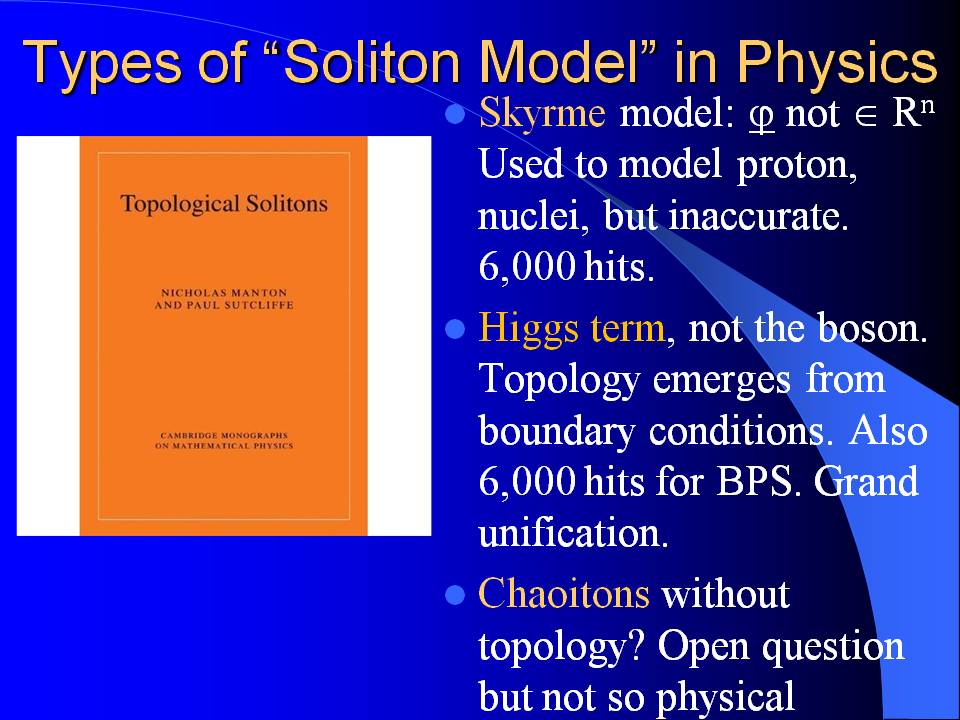

Before going further, I need to say a bit more about what the Skyrme model actually is, in the bigger picture. In traditional quantum field theories (QED, EWT and QCD!) the elementary particles are modelled as perfect billliard balls of zero radius. For example, the electron is modeled as a point in space where there is mass and velocity, and electric charge. The electric charge results in a “Coulomb field,” the simple field of repulsion which pushes away other negatively charged particles or atoms. But it turns out that the total energy (=mass, by E=mc**2) of the electric field in those models is infinite. QED handles that by assuming that there is also an infinite negative mass located at the center of the electron, offsetting the positive infinite mass in the Coulomb field. Plus infinity plus negative infinity adds up to whatever you want it to add up to. (I still relish the wonderful look of disgust on the face of one of the pure mathematicians as I reviewed that.. and emphasized that I have been looking for another way.)  In physics, “soliton” models are models of particles which implement a different picture. They model particles as whirlpools of force, spread out over a “large distance.” (In this case, a large distance is about a femtometer, a millionth of a nanometer. Atoms vary in radius from about a tenth of a nanometer to about three-tenths of a nanometer.)
By the way, if you doubt what I am saying here about QED... I cited Mandl and Shaw in my seminar. The “infinite negative mass energy” is called dM, a “mass renormalization.” Sometimes people say “It isn’t really part of the theory, it’s just a number we put in there to make the calculations work out.” A number put in there as part of how predictions are made. Hmm. It reminds me of a talk I once heard form a guy named Aharonov at NSF: “My viewpoint yield totally different predictions from the usual ones, but I am still assuming the same theory. I just INTERPRET the theory differently...” When I learned about the scientific method, they would say that two different systems which yield different predictions are different theories, not just different interpretations. That’s part of the definition of the words “a theory.”

As the slide illustrates... there are three kinds of “soliton” model of interest in physics. Three ways of trying to describe or explain elementary particles as whirlpools of force. Mathematicians do not like to call these whirlpools “solitons,” because they have their own definition of the word “soliton,” different from what physicists use. So I said: “Hey, we agree that a sea horse is not a horse. So a topological soliton or a chaoiton (chaotic soliton) does not have to be a soliton.”

Many years ago, I defined a new concept of “chaotic soliton” or “soliton” in papers in the journal Chaos, Solitons and Fractals. It was a very natural concept, like what a mathematician would expect here. A “chaoiton” could EITHER be a stable fixed pattern of forces concentrated in a small region of space, a pattern which goes off to zero far away from that region, or it could be a stable SET of patterns, oscillating between each other but still staying there and not just dissipating away.

But then I read the yellow book, MRS. MRS actually described TWO types of “topological solition,” the Skyrme model type and the “BPS” type. Both are a bit of a stretch for a mathematician. Both model an elementary particle as a kind of “knot” in space, a knot which simply cannot be unitied, because the knot connects the particle all the way to space infinitely far away from the particle itself. The force fields describing the particle include at least one field which does NOT go to zero far away from the particle.

MRS even included a “theorem,” the “Generalized Hobart-Derrick Theorem,” which argued that objects like chaoitons simply could not exist in ordinary models of physics without hard-wired topology. I looked at the two page “proof,” and did not believe it. I wondered whether  Rybakov or Sanyuk might have worked out more of the details in their original work in Russian, or at least more explanation of what they were talking about.

And so, I tried to get more information. I spoke to the guy whom I funded who had a subcontract to Dubna, and visited the place often. He tried hard to bring back lots of information, but he really had nothing to say on this. But then... here in the US, at a conference, I met Ludmilla Dolmatova... whom I later married, but who did return to Russia and France in the meantime. In that mean time, she visited the offices of Rybakov and Sanyuk at Moscow State University, and obtained what they had, and had some good conversations --   but it did not really change the picture on that “proof”. (Yes, this was a huge thread in my life... but... back to the book...)

Can chaoitons exist, and could they be a possible model of electrons or quarks?

I made contact somehow with Prof. Pego of the University of Maryland, whose work on... solitary waves?... was perhaps the closest in the world then to what I had done with chaoitons. He had a PhD student, Lev Wertheim, whom I knew from Adelphi Quaker Meeting, who was also an all-Soviet mathematics Olympiad winner. We all agreed on a possible thesis project for Lev: to try to prove or disprove the alleged “Generalized Hobart-Derrick Theorem.” He already had access to my papers and Pego’s, through the usual US systems, but he needed, above all, the two pages of MRS stating the alleged Theorem and proof.

I intended to give Lev just the two pages, but life was very complex for me at that time, and I wasn’t able to get the xerox in a timely way, so as Quaker meeting I handed Lev the book and said: “Lev, I apologize, but I have to ask that you xerox those two pages yourself, and then return the book. But before I do, I want you to promise, PLEASE do not try to read the rest of the book. It is like a Godel-Escher-Back painting. It will drive you crazy if you try to make sense of it.” He promised.

A few days later, I was informed that he had been hospitalized, and I was invited to visit his apartment where his suitemates would return my book to me. “What happened?” I asked. “Well, he seemed normal and alert and intelligent as always, when he returned from Meeting. But then he sat down in that chair, and started to look at that yellow book.  At first he looked at it, and then away, as if he was very torn about whether to open it. But then he did. He started paging through it... slowly at first... page by page... and his eyes started glazing over. And then... well... we had to call the mental hospital.” A few days after that, they reported that the mental hospital had decided he had to go back to Novosibirsk (Siberia) where his family was, and he never returned to physics after that.  What kind of music did he take up then? I do not know. I imagine mournful old Jewish songs on ... old type string instruments.

So... reader beware.

For the seminar, I displayed instead a newer book, by Nicholas Manton of Cambridge University, which I hope would not be so risky for mental health. I do not know how easy that book would be to understand, for a first time reader, since I already knew much of the stuff when I bought it, and I read quickly up to chapter 11, which had some very exciting advanced new stuff. (Also some stuff much scarier than mere thermonuclear devices, for those who understand.) Manton talks BOTH about the Skyrme model and about the family of models related to the famous BPS topological soliton. And he talks about EWT, which makes contact with real experiments and predictions much more than QCD does.

Manton may well be the most important thought leader in the Western world today on the Skyrme model, and on ways to use that model in real nuclear technology. He is mainly known for a huge cross-cutting consortium, which uses the Skyrme model to predict properties not just of proton and neutron but also of small nuclei. Predicting nuclei... is meat and potatoes for practical places like Dubna and Livermore. His consortium has done very large-scale computer simulations, all simulations of the Skyrme model in just three dimensions of space... which is a lot easier than computing with a theory like QCD which requires lots and lots of dimensions. But the accuracy is not so impressive. Errors on the level of 20% and 40% compare well enough with other phenomenological models, but they aren’t exactly correct. What’s more, even if we question the exact details of QCD, we do know very well from high-energy experiments that the proton and neutron are made up of smaller and harder elementary particles, called “partons.”. (Basically, these are scattering experiments, like what Rutherford used to show that the atom has a small nucleus. The word “parton” is a good search term to learn more about those experiments.) So the Skyrme model is useful, sort of, maybe, but we should be able to do better. The “quark” model is just one of many possible models of what partons are like.

After years of digesting MRS and other things... I now believe quite strongly that our best hope of understanding electrons and partons is to model them as the OTHER type of topological soliton, the “BPS” family. The Skyrme model has limited accuracy, and does not really model partons anyway. The mathematics is less rigorous than the BPS mathematics, and “less rigorous” really means “lots of stuff that may be dead wrong.” I now have a much better idea how to construct examples of chaoitons in simple, ordinary field theories... but I am not as motivated now to resolve that issue, because I don’t think they are as plausible as the BPS type of model. Above all, in real physics, we see a very amazing quantization of electrical charge, the exact same unit of charge for all kinds of particles and compound bodies. In principle, that quantization COULD be just an emergent outcome of field statistics... so maybe the electron could be a chaoiton after all... but for now it seems both easier and more promising to work with the BPS family, where the quantization of “charge” (the winding number of the knot in space) is strict and easy and natural.

The key to the BPS model is the inclusion of a term called the “Higgs term” or the “Higgs force,” which is similar in a way to the famous Higgs boson, but NOT EXACTLY THE SAME. The Higgs force is the one which does NOT go to zero even infinitely far away from the particle. The “knot in space” is the knot formed by the vectors of the Higgs field, considered in spheres surrounding the particle.

The BPS family of topological solitons, using Higgs terms and assuming Higgs fields, is very well known in physics. In addition to Manton’s book, there is a simpler review paper written by Erich Weinberg of Columbia University. The physicists assume they have proven “well enough to be sure” that all these Higgs type topological solitons are rock hard stable, just like the electron, but no, they haven’t, EXCEPT for the one specific case of the BPS example, which is the limiting case of a simple model in the case where the Higgs term actually goes to zero! (A mathematician at Harvard really proved stability for that case, I think, basically using special boundary conditions INSTEAD of a Higgs term.) Even if I think more like an engineer than a physicist these days.. even engineers often have higher standards of proof here. I can imagine how these “stable” solutions might actually collapse into a point, or diffuse away into nothingness, even without any change in the “winding number.” I am not convinced by the existing “proofs” that this would not happen for some of the Higgs types theories. I really wish a solid mathematician would get in here, and either PROVE what Weinberg says, or provide a counterexample, and give us some guidance about WHICH Higgs-field models actually work.

But none of that is all electron or a parton yet. **IF** we had a good Higgs-type model of the parton, we could use that for practical nuclear simulations, just what Mantyon has been doing, but hopefully a whole lot more accurate. I could imagine using such a model “tomorrow” to improve Livermore’s ability to predict what actually happens when a laser pulse hits a deuterium/tritium pellet target, a subject of immense importance in trying to develop a new safe energy technology here. (I hear that Livermore’s laser fusion work is funded based on its spinoff value in making nuclear weapons design easier and more reliable. I suppose the new model could be useful there as well.)

In fact, I do have two candidates for what that model might be, much better than the earlier candidates I played with in past years, published in various places. These two new models basically fix some problems I found when I studied the earlier models. (When I first learned about the BPS model itself, I had some hope for it; I had to fully understand WHY it is not a good enough model, even for grand unified theory, before I knew how to do better.) I have not published the new alternatives anywhere, in part because Luda has urged me not to do so until/unless a higher impact journal agrees to publish the details. I did include them in a paper I showed to Marlan Scully and a couple of other people, and I included one of them in the slides I showed at Memphis last week. A lot of very basic work is needed to work out what stable soliton solutions these two new models have, and what properties they predict for nucleons as combinations of such partons. (I have of course studied a lot of what is known about strong interactions as a filter here, EVEN THOUGH I still propose that we use EWT itself with changes only in the Higgs term and in the representation of what the key B and W fields couple to.) Of course, such work might point to a need for further upgrades or tweaks, before such models could actually do better in Livermore than what they already have. We could still simulate the new model in three dimensions, as with Skyrme model, but partons are a bit smaller than protons, and one would have to use multiscale modeling to make it as routine and easy as the present models. (It is still in three spatial dimensions, however, making it a whole lot easier than simulating QCD!)

--------

That all is the normal part. If I were in graduate school, I would happily see how this could be a worthwhile life’s work... but as someone retired and  close to 70, scheduled for cancer surgery next month, I just write it up and hope no one else will have to put in so much effort as I did to see how the pieces fit together.

A couple of quick notes. My old teacher, Julian Schwinger, had a different theory of what the partons are. I believe it is very important that we NOT have premature religious commitment to either his model or QCD at this early stage. Some Higgs-field models based on extending EWT would yield solitons more like quarks, and some more like Schwinger’s dyons, but it is too early to restrict our choices. The basic mathematics and tools need to be further developed, and we should start with the simplest models
(like the two I now have) which seem like they might work for now. Yes, we could insert many topological charges to fit QCD more precisely, but why? For now, two might work; it is easy enough to add more, if and when we have solid guidance on what kind of tweak is needed of that type, if it should be needed. (I doubt it.) Some Higgs type models of the parton (and electron) would also predict a rigid conservation of what physicists call “baryon number,” but others, like the Russian work described in chapter 11 of Manton’s book (probably held secret now in Russia) would not. My two versions probably would not. If not... as Manton describes, and many Russians attempt... then it may be possible to “burn down protons and neutrons themselves” for energy. Basically, that would allow construction of devices like thermonuclear weapons, but about a thousand times as powerful, potentially using any materials at all as fuel.  Manton observes that this would require a special kind of coherent radiation as a catalyst. My slides for Memphis describe an extension of the Glauber-Sudarshan coherence theory  (the basis for designing lasers) which would be applicable here. I am amused that one of the key Russian places working on this, according to Manton, is the Institute for Nuclear Energetics in Protvino, where Luda obtained her “first PhD.” But no, she did not work on that project. There is also some connection here to the lower-energy lower-frequency stuff which Schwinger worked with in the last years of his life, also pretty wild. See http://drpauljohn.blogspot.com/2016/02/korean-rocket-and-navy-lenr-illustrate.html  . But hey, that’s for the further future. Testing the new Lagrangians mathematically and aiming to assist Livermore type of work is all I would write about at all, if I were more confident about either my personal long-term survival or the long-term survival of key actrivities in the US.


=============
Final note: this whole post elaborates on some aspects of the first part of a 3-part presentation with 33 slides in all. Another slide elaborated on the various concepts and measurements of the radius of the electron -- after noting that the "radius" of a whirlpool can be defined and measured in a variety of ways, and noting how MRS discuss the different values for the radius of the proton, all valid, explainable by a topological soliton model.

The second part dealt with distribution functions in Fock-Hilbert space, basically explaining my paper at arxiv.org on my extension of the Galuber-Sudarshan methods to three and four dimensional space. Part of that is a theorem showing that the energy levels we get from simple computer simulations are close to identical to those predicted by canonical quantum field theory (and maybe exactly identical, depending on how we interpret the usual self-energy corrections, like what people use to predict the Lamb shift).

The third part dealt with more recent work, which is what my own thinking is drawn to more lately. I mentioned my joint paper with Ludmilla in the journal Quantum Information Processing, which came out just a few months ago. More people at Memphis also expressed interest in the third part, because it has a connection to their work in graph theory, stochastic graphs, and emergent behavior like sudden phase shifts (which they see as analogous to the sudden drop of an electron from a high energy level to a lower one in the atom). TBD. 


Sunday, March 6, 2016

Unthinkable things which might happen in North Korea and elsewhere

North Korea has put its missiles and nuclear capabilities on hair-trigger readiness, in reaction to the new UN sanctions.

The new stronger sanctions were based on a reasonable conclusion that present trends in North Korea are 'way too risky to neglect, and that we need to bite the bullet on what happens there. Nevertheless, when we bite a bullet... will we get badly hurt, as part of the price, and will we ever be free of the worst case?

We should not be intimidated by those people, but what happens if in fact the guy is as crazy as we think he might be and he actually does launch something as his internal situation gets worse and worse? (Or, on another level, what does he see of our vulnerability?)

It is good that the US is deploying more antimissile capabilities to the area, but if all we get is hit-to-kill over the ocean or over South Korea, will a lot of people die in South Korea itself in any case?

This reminds me of how we COULD have had affordable space-based boost phase intercept by now,
above all if sheer corruption had not blocked our development of low-cost mass access to space. It makes a big difference whether the interception occurs over South Korea or over the launch site (North Korea or at least close to North Korea). If a major part of North Korea becomes a sea of glass as a consequence of THEM launching a nuclear missile (soon or ten years from now), that is a whole lot different from a major part of South Korea being fried that way. The world would be rather shaken up if the US replied to a North Korea strike on South Korea by turning North Korea itself into a sea of glass; it would be a whole lot less unpleasant if North Korea did that itself as a direct result of its own nucs, with far less damage to South Korea. The difference between today's antimissile capabilities and boost phase intercept is really huge, when we get realistic about the kinds of dilemmas  we may be facing in the future,

Why don't we have this capability? I remember when Lockheed and others discussed this option at a meeting in the Marshall Institute, and I went back to the legislative director for Senator Specter (on the Senate Defense Appropriations Subcommittee at that time) to ask about it. "The reason we don't do it is very simple. Too much cost." The cost would be orders of magnitude less if we implemented
a design for reusable launch vehicles, initially developed by Boeing but refined by Ramon Chase of ANSER about ten years gao, backed up by lots of peer-reviewed publications in AIAA venues and elsewhere (including rigorously peer-reviewed NSF-funded work). The cost estimate of $200/pound-LEO (and near term availability) withstood very intense scrutiny... and with that... we could have gone ahead and had protection from the very, very serious problems emerging here and now (and not going away soon).  Not perfect protection, but enough to prevent the much more serious worst case possibilities in play more and more. A factor of ten reduction in the likely cost to humanity of such bad things, which would cost a whole lot more than the new RLV, which would have many other profitable civilian benefits as well, important to sustainability in the larger picture.

Makes me wonder: would anyone in South Korea be interested in developing the core launch capability which the US should have done many years ago, and did not because some folks wanted to use the NASA budget as a cash cow jobs program and wanted to keep the world from following up on really serious alternative technology? (I saw quite a bit in my personal presence.)

At one point, I was hoping that maybe Donald Trump might crack down on the kind of corporate welfare legalized corruption which has prevented the US from developing what it could have... what we lost when Senator Shelby asked for Admiral Steidel's head on a platter.. but this week, a Politico story said, roughly: "Since Trump says he will be the new Teddy Roosevelt, cracking down on legalized corruption... the debate asked him how. He said 'just abolish EPA and Department of Education.'" Oops!! That's not what would get us a new RLV or boost phase interception!! It's more like what Lindsay Graham said ... a choice of a firing squad, versus the other guy's poison... and a third guy's calm support of Cheney style stuff which risks World War by another direct path.

Best of luck. We really need it.


Thursday, February 25, 2016

IEEE Conference on Big Data From Health to Brains to Stars

IEEE Conference on Big Data From Health to Brains to Stars

IEEE is the world’s largest professional society in engineering, with more than 400,000 members all over the world. Most of its societies, like the Computational Intelligence Society (CIS), have a significant surplus of cash from their conferences, journals, and magazines. Last year, to “give back” some of this money to the community, CIS held a competition to fund ideas for summer schools or conferences. That is how they funded a “summer school” (a large workshop) last week on Big Data in Computational Intelligence: From  Basic Principles to Large-Scale Applications. The conference was mainly made up of seven 1.5-hour talks spaced over two days, illustrating the key role that big data and computational intelligence tools can play on areas from health care and environment to brains and stars. I gave the first of these, bringing together the big picture both on risks and opportunities and on the underlying mathematics. The organizer, Nian Zhang of the University of the District of Columbia, plans to post the talks on the web, and had important assistance from others in the community. The talks and speakers, coming from great distances, are described at:
http://www.udc.edu/winter_school/IEEE_Cis_winter_school.htm

Here I will not post my own slides (even though they were quite colorful and took a lot of work).

In fact – I apologize to you. UNLIKE most of my blog posts, this is NOT written to be understandable to anyone except me. These are just my notes to myself after the conference, and preparing for a seminar I will give in Memphis. I usually do not post my personal journal entries, but ... just once, it should do no harm, I hope.

=======================================================
=========================================================


The UDC conference last weekend and the coming Memphis challenge have both been very stimulating to my thoughts – enough to remind me what I have been missing since retirement, and to remind me it would have been better if I had always taken the time to write down the insights I get before I forget them. Robert Kozma’s talk at UDC was “from brain to stars,” and indeed the new thoughts out of my usual daily routine mainly come in those two areas.

But: a lot of it builds on previous hard thinking here at home (easier than at NSF as schedules and culture get more and more hectic), and on the challenge ahead. Bit by bit, I feel called to broaden my attitude on about three things (as noted on page 87 of X2015, which I wrote in “like the old days” yesterday, sitting in a comfortable wooden chair with cushions tilted back, in this study, with new age music – Mannheim Steamroller and Kitaro – playing in the background, through this computer): on brains/minds, to get past “point prototypes” and the early syncretism model, to a full-fledged appreciation of Jungian things from math to noosphere; from Z to richer structure of time tracks (evaluating data of course); and – more today in particular, related to seminar to be given at Memphis – richer understanding of emergent behavior of nonlinear dynamical systems.

To some extent, my core job at Memphis is just to present what I have already done. The challenge is to make it comprehensible. Yesterday and in bed this morning, I tried to do more, to deepen the understanding... but because of limited time, I need to just record the basics of the new stuff and the new questions (incomplete as it is) this morning, and then freeze it, and move on to preparing talk (and reading Yury’s thesis).

Luda this morning reminded me that I need to be very careful with HOW I define my terms for Memphis. For example, I can take time with definitions, so long as I use the right language. Functions, distributions and measures are OK, but I need to be careful not to use the word “field” in a way which conjures up terror. But there is the advantage that I can say “look at this small special case” and not worry about people noticing I have included the whole universe and a highly multidimensional continuum of its relatives.  Are PDE dynamical systems? Sometimes yes, sometimes no. Dynamical systems are allowed objects, and I guess even definable. In fact, I do need to review a lot of ODE (and/or Prigogine space) objects to put it into context anyway, from Mehta to Boltzmann like.

But in the green notebook yesterday... there were ideas I also need to get down on computer, for two reasons: (1) to consolidate the logic a bit; and (2) to make it readable by me, with the major issue of eyestrain now permanent after cataract surgery. (A big ugly red hemmorage removed any doubt that I must be careful now as long as I live!)

My initial goal (when I sent abstract for seminar to Robert) was to explain the new generalized Boltzmann distribution (in a couple of forms) given in my “extended Glauber-Sudarshan” paper in arxiv. presented in 2014 in Scully’s workshop.
In practice, the consequences are almost the same as those reported in my much older cond-mat paper: for continuous states S(t) a probability Pr(S(t)) which is just f(E, C1, ... Cm)dS(t), where f is some function of energy and of the m conserved quantities of the theory. (m=0 is an allowed possibility, but the approach breaks down when there is no conserved energy.) This differs from the old idea that “the universe must go to a disorderly heat bath” (which Harold Szu reiterated at UDC, referring to a debate between Boltzmann and Poincare) because in the PDE case the derivative terms in the energy function do insert some connection/correlation between neighboring points, at infinitesimal separation. Still, that seems to suggest, on the surface, that the emerging order (pdf not well-approximated by the independence assumption across points in space) is mainly at a small scale.

Yet... I feel called to try to stretch further and be more open. So when I read Modesitt’s new novel, The Solar Express, I did take notice of his discussion of systems where there may be more pattern/regularity/order at LARGER distances than at smaller ones. (And of course for years and years I have remembered a paper by Wheeler, where he talks about neutrino temperature and tweaks things to account for the glaring fact that there are these objects called planets and stars, rather fundamental to what we see.) How does that work? Can that kind of patterning be understood/explained within the confines of first-order Hamiltonian systems, using the energy term f and not the invariant measure dS as a source of rich emergent behavior? Precisely how do open systems change things – remembering that there is such a thing as classical chaos in conservative systems (was that chaotic three-arm broom balancer due to Poincare?...)... and that the universe as a whole is presumed to be a closed system? (e.g. If chaos can occur in Hamiltonian systems, why not fractal patterns?)

First observation: I have ALREADY looked into emergent order, without naming it as such! The Boltzmann distribution is a function of conserved charges Ck, as well as E. It is precisely one of those conserved charges, the topological charge(s), which leads to that very important example of patterning or order, the topological soliton – i.e. the true elementary particles, the very foundation of everything we see on earth! Even more interesting... albeit just at vixra and my follow-on internal journal entry... “local minima” in the classical energy function also lie behind the various metastable states of atoms, as was worked out in some detail there! So YES, the Boltzmann term can do it, can generate “macroscopic” order on distance scales as huge as the Angstrom unit, so many orders of magnitude larger than the femtosecond scale we start with for the elementary particles. Two quantum jumps to greater distance already, just based on f(E,C1,...Cm)! Beyond that, what comes next are solid objects, things I know well from quantum electronics and photonics, and they certainly have interesting Boltzmann-based patterning varieties. I remembered Roger Lake... how the same topological soliton kind of pattern distribution can be elevated to the ordinary laboratory level... and the quantum separator (QS) at that scale. (Not to mention some of Von Neumann’s ideas about life.) So already with closed PDE systems (DO I SAY “CLOSED” OR “CONSERVATIVE” AT MEMPHIS???)... the energy term DOES allow all kinds of neat stuff. This week, I seem to be supporting Poincare as much as Von Neumann... maybe I need to look him up more... later...  (though for Memphis, it might help to show links...)

Now of course, the patterning we see with life on the surface of the earth (and the neuron example in the Solar Express,,, which I probably should WRITE DOWN when next I visit Central Library)... is due more to the injection of forwards time free energy, light from the sun. But what specific kinds of boundary conditions count as “forwards time free energy”? It is embarrassing how elusive it is to try to pin that down. In a way, we may not really NEED to formalize the GENERAL idea; we need Pr- and Pr+ boundary conditions at final and initial times, and that’s enough; more may not even be inherently well-defined, as it is ultimately just a rough way to characterize emergent statistics and specific local experiments/systems. But if we can see something more clear and more universal, it could be nice...

As I think more about that... I am intrigued by the possibility of getting more concrete (more specific, useful) results form a couple of special cases of “open” systems, which I think of as the “uniform light” and “cosmic ecology” examples/cases/paradigms. In the “light” example, we still have PDE, which can be represented by spatially uniform additional terms violating time-symmetry and/or energy conservation. (Now that I think of it... we have not proven that uniformity in 3D space would work... a vast ocean of light model ... in generating life as well as our local light does, entering in 2D. So many issues to explore!) Can we get nice equations for that? The cosmic ecology would start more concretely... considering things like rates of stuff ejected from black holes, gross recycling of stuff keeping the universe alive, described as close to ODE as possible... trying to keep it as simple as possible but real. (That reminds me of very important new supernova results from Kozma/Chile, which we will pursue after Memphis and after a brain exercise if all goes well.)

Thinking about the “light” example... it is striking how my previous results (in “Extended..”) really did rely on energy conservation. Yet shouldn’t the concept of equilibrium probability be expressable in a USEFUL closed-form way for density operators in the general case? In my mind... I think of how the basic Hamiltonian dynamics translate into dynamics for rho, with an obvious equilibrium condition. But isn’t that condition in the GENERAL case (e.g. including light systems) about as useless as Wiener’s nonlinear statistics, and in fact quite similar? It reminds me of the inherent problems in reification, and the inherent stuff in Arnold and in chaos.

So: for later. Something probably is there... some ordering... but not this week.

============================ brainy stuff:

Perhaps I should also type some of my thoughts about brain/mind/NN which came during UDC. Much fuzzier, and not part of an active goal beyond my own mind... but... whatever.

I was disappointed, of course, that Polikar – who seemed on course to solidify and upgrade syncretism, to address the crucial issue of real-time learning in brains – has drifted away into drifting away. A lot of the questions his new community are asking about nonstationarity are no more puzzling than causality, and perhaps I should have written some of it down earlier. (I have always had too much stuff to be able to publish so much as half of it.) Yet he has some stimulating questions, if the right questions are pulled out and played with.

For example: he asked (with some reification here): “What if we have two sets of variables, Y(t) and X(t), called labels and data? What if we have some initial data on Y(t) and X(t), and then a WHOLE LOT more data on X(t) later, especially in a world where relationships may change?” I urged consideration of two examples, an “auto” example and a linear example. In the auto example... Ford might have millions of data points on Y(t) and X(t) from thousands of engines or batteries, fully instrumented in the lab, followed by later getting billions of data points just from X(t) from cars on the road. (Hypothetical, assume wireless “phone home.”) The obvious approach is to learn just from the laboratory data, but also learn soft sensing to predict Y(t) from history of X(t) for use on the road. (Feldkamp and Prokhorov have an important soft sensing paper in Narendra, which I even repost on my own www.werbos.com/Mind.htm.) Later X(t) doesn’t do much! HOWEVER: in principle, one could use X(t) (predicting X(t+1) from X(<=t)) to find proper “hidden nodes,” preferred encoding, which one could then go back and use to REMODEL the laboratory data. ALSO: observing the range of variation of the later data, IF it is larger in some dimensions than the laboratory data, one can use it to put special weight on trying to get accurate measurement of weights which will explain more of the variance in later observations, a possibility for value weighting. (Still, a concept much trickier than Vapnik understands.) The linear example reminds us... if covariance of X to X changes, why not X to Y.... which rather grossly invalidates that kind of exercise.

-

I worked hard, in preparing my own talk (recorded by UDC, to be posted), to try to avoid being as depressing as I have been lately at home. Probably death of the entire species really is depressing, more so than my cancer, which still bugs me as well. I did not mention climate change hardly at all. But Diego, the final speaker on the first day, got into great detail on the kinds of stratospheric ozone effects which, after H2S upwelling from oceans, seem likely to get worse enough and be the first thing directly fatal to human life from climate as such. He also did a lot of mixture of experts modeling, though he did not remind us of what is or is not known about that general power of such things. Is there any such? I remain skeptical, and skeptical of its relevance to brains. Yet I must admit... that Jungian archetypes are beyond the point prototypes of classical syncretism, and that mixture of models thinking might be adaptable to that general case in a reasonable way, for noospheres if not for mammal brains. Worth thinking about, along with dynamics and drift of prototypes in general.

The final talk by Kozma included example of a solar surface model by Catalina Terra. (Met her to be sure!) Amusing what degree of parallel with Modesitt’s story... different desert, but still...

Wunsch objected to use of PSO to optimize, a comment I certainly found friendly. For general power, we need to get past methods like PSO which do not offer a good ratio of parameters-handled to number of examples explored... yes, use derivative and hence the chain rule for ordered derivatives... but when a dozen or two free parameters can do the job, priority in becoming more scientific involves two different upgrades, as I said to people: (1) technical aspects, related to what they are modeling now; and (2) new questions, the most important.

Re (1) :”Did you train and test?” It is remarkable that one PDE type model (even if with nonlocal field effects) could start form the beginning and track the long history of light emission from any star without new data coming in. (Or did it? Train and test needed.) I have seen cases in chemical engineering (my papers with McAvoy) where such was possible, but others in economics (my 1977/8 SMC paper predicting conflict in Latin America) where it was not, because of something... a general form... of “phase drift,” shown in my slides for UDC. UNLIKE the “nonstationarity” community... we have a compromise method which can address this kind of thing...  one more thing which needs to be translated even now... and a fundamental thing at that! (Some of the other things Polikar talked about can be modelled simply as hidden variables in time-series model, no fundamental significance at all, except insofar as some parameter values need to be thought about...
part of the universal vector intelligence game). Even now, I guess I need to be even more brutally explicit to the world in explaining/defining the basic mathematical concept of vector intelligence.

========================

From UDC, other loose ends... tell Lily about MomLink, Maia about Harold’s earthquake model (communicated and translated better) and Wunsch’s effort to use ADP on iterated prisoner’s dilemma (and his hypothesis about decomposing some types of games into “easy” and “PD-like”.) And Chawla’s health systems... maybe even related to my health! Luis for political cooperation? Whatever... if time allows.. I did look up Gulen, and need to explore loose ends in that area.

Anti-aging also came up, at UDC and in Solar Express, at many levels, from structures to people to ,... well, I always think about noospheres too. It too relates to the Boltzmann world, but has to be managed carefully in the weird environment we are in today.


Monday, February 22, 2016

Who is Donald Trump Really, and Who Would He Turn Out to be If Elected?

Who is Donald Trump Really, and Who Would He Turn Out to be If Elected?

All of us who vote in the US have a very serious, high spiritual duty to think hard and meditate seriously and honestly on that question this year – just as we have the same duty for Hillary Clinton, John Kasich and Bernie Sanders. (I have said enough on the others for now.)

Yesterday, as I scanned CNN briefly while doing other things late in the afternoon, an image flashed into my mind, helping me see deeper into this question. Briefly: there are fascinating parallels between Donald Trump and Newt Gingrich (whom I know much better).  In particular, Trump’s deep love for his current wife suggests strongly that he, like Ronald Reagan and Gingrich, really has made a deep shift in his views of women’s rights and the Supreme Court, just as he says he has.

==================

That really was a brief thought, and probably a lot easier to understand than most of my brief thoughts. But it leads to a lot of related things.

For one thing – why does it always seem to take forever to explain some of the things I see briefly? There are a couple of reasons. Sometimes, when the thoughts come at a level of higher intelligence (typically around 3AM for me), they are intrinsically complicated and draw on a web of knowledge and memory beyond what I really draw on later in the day, especially in late afternoon and evening, when there are times I can hardly even do a difficult sudoku type puzzle let alone something more meaningful. But even in the afternoon – my brain has learned categories, “hidden neurons,” representations, concepts which are not shared by everyone and are called by different names even when shared. Also, associations with unique memories play a key role. At the Quaker discussion meeting eight days ago, someone commented how the term “suffering servant” is universally understood by Amish, in a way which lets them communicate very quickly some ideas which would take a lot longer outside the community. (I noticed how huge the gulf is between their concept of Jesus, as a suffering servant, and Constantine’s view, visible in a plaque as one enters Hagia Sophia, depicting Jesus and Constantine as co-creators and gods of the universe. Luda asks: “Why do you always bad mouth Constantine, like Dan Brown?” Yes, I am simplifying, but... save that history for another time. )

For another thing: what do I know about Newt Gingrich, and how, and how does this analogy work?

I have met Newt Gingrich in person only three times, and Newt himself... MIGHT vaguely remember just one of the three times, maybe.

The one he might remember vaguely was in 2009. Do you remember the concept of an “elevator speech?” Someone, somewhere, told people: “You need to have an elevator speech ready. You need to be ready to express your most important ideas really quickly in 30 seconds, in case you just happen to find yourself in an elevator with someone who could make them real...” So at one point, in 2009, I found myself alone in an elevator with Newt Gingrich, on my way from the top of the Hart building to the little coffee place on the corridor which connects Hart and Dirksen. I said something about how a lot of people remembered how he stood up for space, and how important that was, and we are interested to hear what he thinks now. Throughout the 2012 primaries, Gingrich really did stand u p for space, and one of his key constituents actually stayed in my house a couple of days to attend a space meeting we both went to. But at the same time, Gingrich stood up very firmly in support of changing the Supreme Court, so as to vitiate women’s rights at many levels. With regret, I concluded in the end that I had to channel my energies elsewhere, because womens’ rights really are a life or death matter for the very survival of the human species.  I did not want to support being “nice” and “respectful” to a group of people who would then suffer brutally themselves from the consequences of doing so! And I was not alone on that.

Newt would almost certainly not remember the time, during the start of the 2012 primary season, when my back was about two inches from the back of his wife, when he and his wife were seated in the next table to me, Luda and a visitor of ours, in a Japanese restaurant.  He was not loud, but he was rather easy to hear, especially for someone located where I was located. I noticed that he ordered shabu-shabu – the only dish I ever had in that restaurant which was merely mediocre. (Others... include the best regular sashimi I have had anywhere on earth, including Japan, though I guess it’s pretty arbritary to compare it with the special gifu I once had in Nagoya...) He elaborated in great detail on his views of Mitt Romney and on how the campaign might go. But in truth, I followed that primary more religiously than I am following these, and I learned a whole lot more from other sources. I noticed how many people were cynical about how deep his feelings might be towards his wife and human relationships... since his wife then was not his first wife... but Luda is also my second wife, and my own experience tells me a lot about how truly overwhelming and intense a marriage can be for some kinds of people (like me, Trump and Gingrich). Gingrich is relatively independent in his thinking, and far more truculent than most in asserting different views when he has them... but it is crystal clear that meeting his wife was truly overpowering, and that men and women both change a lot as they move into new territory. Conversion to Catholicism was part of that marriage.

For me... well Luda and I are both even more strong-minded in some ways... and neither of us are storm troopers for any religious organization. (Quakers do not recruit storm troopers.) Probably I should not say more right now.

But Trump with Melania... he spoke very briefly in that two minute period, but a lot of what he said was very, very familiar to me. Melania like Luda is a very striking and energetic person, and yet not so willing to speak SO much on TV. In fact, she is... like Luda in some ways, but with features of some other women I have known, more from the Germanic side of the world. From Slovakia, is she a Catholic, like Newt’s wife and almost all of my family? Maybe. I don’t know, but it is a reasonable guess.  She wants to defend HER PEOPLE... and it is ironic for me that she defines her people as something more like my family than like Luda’s, and even more like them than Trump’s (though Trump is also of German roots). On its way from the Trier part of Germany to New York, my family did spend almost a century in the Austria-Hungary empire, and it is easy to recognize familiar things... Many parts of the Slavic community actually do share many traits with the German community (reminding me of my great-grandmother whom I knew well as I grew up)... and in that area, both had to cope with issues of relations with the Islamic world.

It is sad that litmus tests are now so insane in the Republican party ... that they freeze our choices so much, in such a bad way!! So Trump’s sincerity here bodes well for his nomination, but will present a very, very serious challenge for the general election.

But... Luda is now active upstairs, and I will go join her... 


Thursday, February 18, 2016

A Dream From South Carolina

A Dream From South Carolina

Just an amusing story from the day watch, too funny to ignore...

Floating around, I met a regular guy from Ohio, named John, who said:

“Hi, Paul! Am I glad to see you. Come to think of it, am I glad just to be HERE. I joke woke up from the weirdest dream.”

“Tell me about it.”

“Well... I was the only human being there, except for the bartender, in this big dark bar in South Carolina. In the front of the bar, there was a big nasty fight going on, between a totally enraged uncontrolled big wookie, right out of Star Wars, and tall thin snake, who was black, whose tongue was slithering out at everyone, but still standing somehow on two legs. They were making a huge mess, and it was getting very scary.

“Besides me, there were only two dogs and a large sized baby doll. The baby doll was real just like those little dolls from the 60’s – you pull the string and it always says “Mama! Mama!” the exact same way, and it cries real tears. One of the dogs was a very nice friendly lost puppy, a kind of dark hound dog, who sat in a friendly way next to me in the back, and we both looked together towards that mess in front with sadness and amazement. The other dog was a yippy chihuahua who kept trying to join the fight, and bite the snake and the wookie. It kept yapping the same yap over and over again, to where I began to wonder if he was actually a robot too, like the baby doll.

“But then... the bartender... her name was Nikki... decided she could use a little pet chihuahua, and she decided this one looked cute enough. So she approached him quietly from behind, and started petting his fur and then rubbing behind his ears. He clearly liked that, and was happy with the idea of becoming her dog. He didn’t exactly purr... but became more regular. But for a chihuahua, being more regular meant the same old yap and attempt to bite, more regular but utterly unchanged.

“Well, that was enough, so I looked around the room to see if there was anything I missed. And there, sure enough, in the dark far right corner, I saw... Darth Vader. Yes, the real Darth Vader, complete with wheezing mask, implacable dark force and all. I could feel the waves of focused powerful hatred he felt for that bartender, as she had the effrontery to try to take HIS DOG. But, being Darth Vader, and a bit like a snake himself, he poised himself to act but held himself back just for now. He didn’t want to act until his dog won the fight... and she was actually helping him win... but the instant it was over he was poised to jump in, show her that her effrontery would not be tolerated, and smash all those silly little sunflowers she kept around the place. He would teach her to respect the dark side.

“But... he couldn’t help looking at the snake... wishing he owned it, as it was his kind of creature... but he realized wistfully that he couldn’t, and that if the snake won, EVERYONE in the neighborhood would be dead of a poison bite, the people in the room including him first. Such a snake... a creature of the God Siva, but even Siva renounced this creature. Who WOULDN’T renounce this creature?...

“But then it came to him.. hat maybe someone up there on the other side might plan to throw out half the Republicans from the House and Senate... and if so... this creature might be his unwitting instrument... just as Satan is often said to be an unwitting instrument of God, in those old stories... still condemned and destroyed in the end, but used... not quite the kind of instrument of God the poor gullible people imagine he might be...”

“Well, Paul, I sure was glad to wake up from that dream, and escape from all the alcohol fumes in that room. Does this place have any coffee? I sure could use some right now, straight or with cream and sugar, either way... just so long as it’s not Irish coffee.. no alcohol, not for a long time...”

It reminds me of the old saying by Chuang Tzu (sometimes attributed to Li Po): “Am I Li Po just waking up from a dream of being a butterfly, or am I a butterfly dreaming now that he is Li Po?”

===========

Just for the record, in case you wondered, this was NOT a conversation either here in Virginia or on the "astral plane."  The noosphere has many aspects... 


Sunday, February 14, 2016

Cosmopolitan Quaker discussion of emptiness in the Heart Sutra

Cosmopolitan Quaker discussion of emptiness in the Heart Sutra

After many weeks of snow, and medical and political distraction... back to the Sunday morning discussion with Quakers.

The reading for the day was from the Heart Sutra. The reading was very strong in saying that emptiness transcends consciousness, perception, form, and so on. But it wasn’t so clear on what “emptiness” IS.

After one key paragraph... I tried hard to parse the meaning, to translate the words on the page to something with an objective meaning. (i.e. “What the hell is this guy actually trying to say? Does it mean ANYTHING, really, or is it just empty gobbledegook like a lot of what I hear in the presidential debates?”) We have often discussed passages which have different meanings, depending on how you understand a word which was translated from some other language. But this time, it was a struggle to find ANY possible meaning at all.

After that paragraph, I broke in and said: “Hey! Maybe I can see a way to make this make sense! Please forgive... it’s not EXACTLY a joke.. but maybe ‘emptiness’ here means Minkowski space. It’s something which actually exists (we think) and is important and meaningful, PRIOR TO all the specific field strengths and patterns and states which can exist IN Minkowski space.” One or two people were horrified that I might interpret such an elevated philosophical feeling with something as mundane as Minkowski space... but I was amused a few paragraphs later when the sutra went on to describe the usual stuff (consciousness, perceptions, etc.) as like “waves” and ‘emptiness’ as like the water which the waves travel on!! Hey, that really does sound a WHOLE lot like Minkowksi space! OK so the sutra says we need to think explicitly about Minkowski space itself to make sense of our experience... and yes, there really is that great void, not unlike what we see looking up at stars on some nights.

But before we got to the waves, a different KIND of emptiness came into it. (If one really understands language...it is not SO surprising when humans shift definitions in midstream. It happens all the time. It often happens that the multiple concepts are all worthwhile, but do need to be distinguished to get a really clear understanding.)
The sutra urges us to be “empty” of all preconceptions, to attempt a kind of zero-based budgeting of our thoughts, starting from scratch in a way...

So I said: “THIS emptiness is not the blank slate of objective reality, of space-time, but the blank slate of the mind. (Like restarting from zero weights, a bit.) That is certainly important. ..

“I am reminded how many mystics will spend hours or days meditating on a physical object, like an apple or a fire in the fireplace or on a candle. For myself, I find more and more that there are WORDS which merit that kind of intense, focused meditation. In a way, the most important single message in this sutra is that OPEN-MINDEDNESS, openness, is one of the important words deserving that kind of attention. That is the kind of ‘emptiness’ which really matters here.”

I thought, but did not voice, my memory of Nietzsche’s “withdrawal and return,” of the final “return” scene in Voyage to Arcturus, and of a Rosicrucian meditation where an openness exercise is alternated with a radiant exercise. (And, oh yes, Elizabeth ... Noble.. childbirth exercises...alternating squeezing and relaxing.) The open phase is essential, but is not the whole story, and is not the ultimate goal.

This reminded me... that my concept of first-level sanity or “integrity” or “zhengqi”... can be seen as a kind of unification or “marriage” of the objective and subjective viewpoints,  not CHOOSING between emptiness as Minkowski space (which may be our objective ground of existence, or alternatively whatever space eventually supplants it in physics) and emptiness as our subjective open mind, but fully integrating the objective and subjective points of views, as described in a couple of my published papers. In a way it is SIMILAR to the Alchemical Marriage (level two), but here there is no difference in VALUES between the two (as deep values exist only on the subjective side!),
only in expectations or predictions or cognitive aspects of life. “The mundane objective/subjective marriage of cognition”? But between body/brain and soul, the true Alchemical Marriage is more like a real marriage, a combining of values, a coalition of self and Self.

One person, more established in Quakers than anyone else in the room (including the moderator), asked: “Can I even say I am a Quaker really? I cannot claim to agree with the other things people say Quakers believe? I guess I am like Emerson, who said ‘I am ALMOST a Quaker.’”

But the rest of us noted that Quaker in the modern version (i.e. the new most common mainstream definition of the words among mainstream FGC Quakers) does not refer to specific BELIEFS. In fact, it is more a commitment to being open-minded, just like in the sutra. REALLY open, to all levels of existence. (If it were all mundane, why even come to Meeting? Not that anyone is excluded, if they don’t actively disrupt the group.) One person noted... hey, in reality, we need SPECIFIC beliefs, just to survive, and Quakers do not meet that need. But I note: that is like another part of the sutra, discussing the need and the inescapable reality of the IMPERMANENT – which reminds me of the states S(t) of actual universes or field theories defined OVER  Minkowski space. (OK, so knowing the true Hamiltonian of the universe would be part of the great ‘emptiness’ too ?! Not impermanent...).   The key point is that the greater objective reality, containing both mundane and esoteric variables, is highly specific (as in some belief systems, at least the ones which are not fuzzy and incoherent and logically inconsistent)... but NOT KNOWN to anyone on earth. Yes, our knowledge is fuzzy (to the extent that it has any connection to objective greater reality), but that does not mean that reality itself is fuzzy. Quakers do not CLAIM to know the detailed specifics of objective reality.

I am also reminded of what the US Constitution was intended to be (before various myopic bad guys started twisting it)... a framework, just like Quakers or world-class universities, in which a wide variety of competing ideas could flourish as PART of the larger system, governed by a kind of honorable competition. We ALSO need specific ideas and specific schools of thought, in a flux of growth and change and impermanence... schools like Rosicrucian Order and various orders of Sufis and yogas for example... but no rigidity about the details, and no monopoly nonsense stifling growth or the economy or the freedom/liberation of the mind and of the spirit. Just yesterday... having read Dark Money (which COMPLEMENTS the last chapter of “A G-Man’s Journal,” written by a conservative with vibes like Kasich’s).. I do worry a lot about the hack job lobotomy some folks are doing  on the US lately.... the horrible “Magog” phenomenon just as bad as the “Gog” of the extreme sharia core of the international Moslem Brotherhood behind both ISIL and Cheney (and the patsies and blobs who empower them to make trouble). Will the human species survive? It is too early to rule out the possibility of a Judgment Day scenario... but every spiritless loveless rigid fundamentalist of all religious factions... should realize that this would not be what they want... that they should fear what might be coming for THEM as much as the most atheistic axe-murderer should. I do hope it doesn’t come to that, but the folks I see on TV lately., do pose that possibility. Especially if they should exercise their free will by choosing Cruz! (Unless Cruz truly changes... but how real is that? One may hope but...)

==================================================== 

Of course, I can easily imagine some Zennies I have known going into orbit after seeing the above.
Buddhist clergy is a diverse lot, like Christian and Moslem clergy, etc.; whatever the founders taught, in all these religions, there are always some insensitive folks who use religious dogmatism as a way to pamper their ego. I still remember visiting Nara, in Japan, where people talk to this day about the nasty physical wars between monks with one color of hat versus monks with another color of hat, and places in China where people think one's chances of enlightenment depend n which way one bends the finger, just for its own sake, and they argue and forget which way is which.... 

In Tricycle, the magazine of American Buddhism (serving all groups), I was intrigued to read about the great debate at Samye... circa 670AD?... a place in Tibet... where the "nothingness" (Zen) Tibetan school basically lost the debate to the mindfulness school (which became the main Tibetan school), and then went in exile... to Shaolin. Not a Chinese cult after all. Zen has many great techniques, but in the end... sheer logic.. and any serious mindfulness...  clearly points towards mindfulness as the sane choice, the only coherent choice between the two, in terms of goals. Techniques are another matter.


Friday, February 12, 2016

Tricky Situation for Syria -- and larger context of politics of oil

Tricky situation for Syria

This past month there has been so much gross incompetence on display in some of the debates in the US that other nations... have mixed views of the relevance of the US... to the point where they too risk making mistakes due to overconfidence and neglect of crucial details.

For the situation in Syria, Iraq and Turkey, for example,  I have found it very very useful to monitor France24 and even RT (which was once less useful), for some of the basic facts of life which I wish our candidates knew about. I especially remember seeing McCain protest very loudly about our “loyal friends” being bombed by the Russians – loyal friends who turned out to be al Nusrah, a branch of Al Qaeda! It reminds me of how certain folks in the US gave Osama bin Laden his start, with weapons and training. And it reminds me of how folks like Morgenthau and the UK foreign policy old guard would shake their heads at the wild impulsive self-righteous actions the US could fall into when we do not even attempt a bit of strategic thinking of any kind.

Though in fact there HAS been a lot of strategic thinking playing games in the Middle East... which I am warned not to outline in too much detail. (No, not by any intelligence agency. By stuff more like privacy rights, spiritual principles, and a little self-preservation.)

But... it is very disappointing today to hear that peace talks on Syria have not gone as well as the US, Russia and EU really need them to go. It is a serious matter. Kerry is being unusually clear and effective for a US representative, and the spokesman I see on TV today and yesterday is also unusually clear and reassuring. But... yes... balance is tricky. I can even hear Trump saying: “Hey, you still need the art of the deal here. Look at..” Well, maybe. I have never compared Trump’s Art of the Deal with Raiffa’s work on negotiation... but in any case, it is now a time and place where the dialogue
has real potential but has been hung up. And this IS one of the unusual times (much exaggerated by most Republicans) when the problem actually is in large part lack of respect for EU and US by Russian folks involved.

In essence, key people in Russia seem to think: “The US has proved itself to be totally idiotic in what it did, the whole world can now see that, and so we can now go back to simply winding this up and going back to Assad.” But it’s not so simple.  My response has been: “We in the West really do owe Russia a whole lot of respect and gratitude for all the blood and money it has shelled out to prevent a Sunni sharia extremist takeover of Syria, and we do need to learn to understand how tough rules of engagement are needed at times with that crowd, but Russia cannot afford unlimited flows of blood and money forever.” (I think of a great cat we once had, beloved both of my Russian Romanov type wife and my equally tough son... a cat who got himself killed in an all-out fight to the death with a coyote he tried to keep off our territory. I really would not want the great cat of Russia itself to kill itself that way! Really, seriously!). Folks need to understand the need to try to move to a more sustainable situation.

“What do you folks want anyway?”

Well, it’s not as if the West wants to dictate terms to Russia. That would be stupid. But there is some real analytical intelligence in parts of the US, Russia and intellectual centers in the EU. Surely we could analyze this in a cooperative dialogue, and come up with something a bit more sustainable (less risky and less expensive) than just wasting more blood and money ...

Not being a diplomat, I could even invoke the ultimate insult and ask whether Putin wants to be like George Bush and win in Syria the way Bush won in Iraq. “Oh, no, we don’t have such pride, and we will get out soon.” Yes, and the US got out soon too... we thought. And in all fairness, pride is something we all have to work to overcome.

“Well, do you have any specifics here of things you want other than some kind of support for Assad?”  

“Well... that should be mainly for the official dialogues. But there is one thing for sure. At a minimum, we really need strong safe zones for nonMoslem cosmopolitans, the kind of people who wanted a free Arab spring, with rights and at least some local autonomy. Secure regions. (Even Palestinians have some safe zones in the region controlled by Israel! Zones whihc would be safer if they truly agreed to not attack the others, as I hope the cosmopolitans would agree to here... but here we could agree to international checks. A better and safer use for your troops than the other stuff...)”

“Huh? Who cares about safe zones?”

“Well, David Cameron, for one?”

“Who the hell cares about him? He’s not even a real spokesman for the EU.”

“David Cameron is really crucial here as a peacemaker in the EU. Have you been watching what’s happening in the EU lately? With Merkel versus folks who could really bring us back to full-up Nazism? Do you want THAT to happen, for God’s sake? Cameron has been pushing for safe zones to meet the needs of Syrian refugees, as completely and sustainably as posisble, WITHIN the territory of Syria. There are lots of reasons why we both should be working as hard as we can to make his “third way” really work...:

Well, maybe. It is a tricky time.

By the way, the political prospects in the EU would be a whole lot better if they had any economist capable of understanding more than the hoary old 7-equation models in his or her gut. (The proposal at nss.org/EU is written in ordinary language, without economics jargon, but reflects the policy optimization implications of a more complete multisectoral analysis.) Schroder might be able to catch on... but he is now employed by folks who get money from oil, and it is harder for people to see the long-term picture when they are overwhelmed by short-term constraints.

To wind this up, I append a couple of postings to a US energy discussion list relevant to the context of these conflicts,
supporting Obama’s proposal for a $10/barrel oil import surcharge:

================================================================= Later post:
Another key issue with this tax... is the possibility that today's low world oil price represents a market failure (at least so far as economics is concerned). More precisely: at a conference in Azerbaijan a couple of years ago, I agreed with the majority that the present low price is basically due to the Saudis exerting market power to keep the price low, for reasons beyond what market economics envisions, effectively amounting to their giving a subsidy to the rest of the world economy (in which they have large investments). I argued that it would be a win-win Pareto optimal solution BOTH to move gently to a much higher price AND to push harder the kind of technology development which would allow the world to WITHSTAND higher oil prices without the kind of collapse we saw in 2008.

In other words... if the OECD+China economy (OECDC?) could afford to pay twice as much for oil, without endangering the investments of the Saudis (and a few other financial folks)... the Saudis could cut back production and raise prices, and save more oil for the future, when it will deserve/command a higher price (as true Islamic finance really demands), while we could avoid economic depression and be better prepared to survive in the long term (with more security). 
According to Scheuer ("Anonymous"), overrrapid exploitation of Saudi oil is one of Al Qaeda's three top reasons for attacking the West, and maybe that is the kind of grievance we could "make a deal" on (to quote Trump). 


But part of me is amused... that as soon as I advocated for a higher world oil price, folks took such strong steps to achieve the opposite!!

Well, there are also external variables, like money seriously leaking from Saudi to seriously bad politics. But Obama's suggestion is a great example of what economists call "the theory of the second best": if we can't get our economic Pareto optimum, for whatever reason, and if worldoil is underpriced, we CAN at least get the US oil price a little closer to the true market value of the oil, thereby both helping the US with its budget/debt issues and giving better signals on a level playing field  to activities within the US, which include activities ranging from fracking to hybrid cars. 
(Some theorize that Saudis were not protecting the world economy, but trying to bankrupt oil fracking, where they have in fact had a huge impact. Either way, Obama's action, second-best, makes sense.)

================ Earlier:


Someone asked:  'At these low gas prices'. Cheap is a pretty poor rational for taxation. And to what end? My question is: Can anyone show that such a tax would really reduce the threat of climate change? That is something I'm concerned about.

My reply:


What do REAL economists say about this? I am amused that this question comes after I lectured some family members about Walras, Paul Samuelson, Ken Arrow and Joan Robinson -- real foundations for what we understand about market economics, unlike the growing PR blather which confuses so much of the local discussions lately.

From an economist's viewpoint, I might rephrase Rosemarie's question as: are the externalities here (the additional costs not paid by the person who buys the oil) large enough to justify a price as high as $10 per barrel?

In a way, I might ask Mike to run the numbers. If the social cost of carbon (SCC) is, say, $30 per ton of CO2 (i.e. $90 per ton of carbon as such in CO2), as Mike once estimated, what does that give per barrel? I could calculate that myself, but:

(1) Is that the real SCC? I once thought $30/barrel was reasonable, but now see damage from climate change as far more serious that I once believed:
Naturally, many folks do not have time to look at the logic and think for themselves, and ask: "Why don't we see this in Nature or Science?" Several reasons. When last I discussed this with a friend who publishes regularly in SCience, he said that "It's even worse than YOU think... we all know this... but the political forces repressing it all have grown worse and worse... and we simply give up. I have a nice house on the beach." On the other hand, the problem is nonlinear, and simple externality payments may or may not be enough to give us much hope anyway.
Lately, I am starting to hope that the H2S stink from the smaller problem in the Arctic might wake people up enough to give us some hope of acting in time before the huger fatal problems from the Antarctic kick in (starting in waters off of California, Japan and China). 

(2) THERE ARE ALSO NATIONAL SECURITY EXTERNALITIES.
Some folks say: "The price is oil is low, so why should we worry?" Well, there are some of us who believe that the future of the Middle East is not something we should ASSUME will be sweetness and light, and who also believe that fracking for oil will not last forever either.
Is the ability of the US to survive so much as 20 or 30 years in the future of any significance to any of us today? That's a really fundamental ethical question. In economics, it relates to the very serious debates about the right real interest rate to use in making long-term decisions,
and to the question of what to do in nonconvex or "crossroads" situations. I could say a lot more about that... but in the end, my claim is that competent technical economics is capable of living up to the obvious idea that maybe we would prefer our nations and our descendants to live, rather than die. Politics involving the Middle East really are a matter of life or death, in the most literal sense, for all of humanity,
and there really are very substantial externalities there!

At the end of the day, I do not see the $10-per-barrel import fee (similar to things in Japan and EU) as anything like a complete answer to the climate or security challenges, but do see it as fully justified in terms of the externalities.  GIven a choice between that and nothing, I would choose that. But at the same time... I would really hope that the next elections could be won by folks more serious about a more complete strategy to address both challenges (e.g. per the addendum below, probably close to the white paper approved recently by IEEE
and on the site of www.ieeeusa.org, the world's largest engineering society, which manages the most complete and credible technical peer review system in the world).

=================================================================

My final reply to an offline question:


The Transportation Addendum to the National Energy Policy Recommendations (NEPR) basically elaborates on a section of the brief recommendations in IEEE's National Energy Policy Recommendations (NEPR). The organization felt that the recommendations were specific enough for formal purposes -- but planned to encourage things like face-to-face discussions of specific ways to implement them.

Time has passed... but I seem to recall that one of the recommendations looked a lot like support for some kind of Open Fuel Standard bill, and the Addendum certainly substantiates that kind of thing. In broad terms, I still see it all as consistent with the much more specific legislative proposals, still as timely as in 2009, posted at www.werbos.com/oil.htm

For myself -- if the folks in Washington really tried to balance competing goals in a Pareto optimal way... I would be especially interested in getting folks to consider RATIONALIZING Bush's renewable fuel standard (RFS) rather than perpetuating or abolishing it, as purists of the left or the right assume are the only choices; one section of Specter's bill, posted at www.werbos.com.oil, could be easily adapted to be brief standalone bill to accomplish just that -- substantially improving national security (as "w" envisioned when he pushed all that) while substantially increasing flexibility and reducing cost (the most important legitimate concerns of the industry here). Instead of a war between national security and the energy industry, why can't we go for a Pareto optimum of the two? I really wish someone knew a workable way forward on this... because there is ever so much at stake...

===============================

Added later:

OK, I'm not a diplomat. Comparing Putin to George Bush on any basis whatsoever was not
a kosher thing to do. (But maybe Trump would say that being a good diplomat is not always the same as being diplomatic?). The analogy between what Russia is doing in Syria, even just giving a total green light to Assad (the guy whose recent statements really drive the West up a tree), and George Bush's invasion of Iraq, is the kind of comparison no one wants to think about, Just as no one wants to think about H2S poisoning everyone on earth. We humans really do have limits, and we do have to manage our limits. Just as Putin might not want to think about that comparison, and its unpleasant implications requiring all kinds of complex thought and sticky stuff... I guess I have my limits too. It is equally hard for ME to think about how it is the Erdogan Turks, not the Russians, attacking safe zones for Kurds!!! What do we do about THAT? What an incredible mess. But I have the excuse that
it's not even remotely my job, and I do have two nontrivial personal commitments coming up (for nontrivial talks, one a week away and one about three weeks).....

One friend has even said: "Hey, NOTHING is your job now. Denial is an important defense mechanism for folks who can't do anything anyway."

Yes, but:

(1) I keep remember what Hannah Arendt once said, "All that is required for the triumph of evil is for good people to do nothing"... not to mention Wiesel's poem "there was no one left to come for me"... aptly mirroring the recent transformation of the US executive branch;

(2) George Valliant's study shows quite directly and forcibly that there are OTHER defense mechanisms besides denial, ones which work better,

Giving up would be ever so justifiable and natural... but logic keeps pushing in another direction.