Friday, April 1, 2016

Positano: From Misty Spirit to Comedy/Surgery

Positano: From Misty Spirit to Comedy/Surgery

Positano was just one of three or four places we visited on one day of our 16 day visit and cruise to Spain and Italy. No politics, policy, science or heavy philosophy. Just looking at beautiful sights and relaxing – a window into the ordinary life of this cruise. March 23. (Don't know why camera says March 22.)

We came to Positano as passengers in a van, starting earlier in Naples and going to Sorrento before Positano. Besides Luda and Chris and me, there was a couple from Ohio, three folks from Texas (including the guy who made the arrangements) and a driver, Giovanni.

            As we came towards Positano, Giovanni pulled over to place where we took many beautiful pictures, like this one. But no two-dimensional picture can capture the full breadth and scope of the full experience. (Click on the picture to get full detail.)
Giovanni told us a lot of things about Positano. For example, he told us there are many stories about where it gets its name. Greeks lived there before Christian times, but Giovanni was not an historian or archeologist (unlike our guides in Sicily and Tuscany). We had heard that the name might have something to do with Poseidon, but he told us that the Greek Temples were dedicated to two goddesses (Athena and Vesta I think), and even the main Christian Church is dedicated to Maria. One story is that the city was founded by Greeks moving along the coast from a sister city dedicated to Poseidon. Another story, the favorite in the city itself, is that a ship with Christian passengers got into a terrible storm, and that the icon painting they were carrying magically said “posi! posi!,” teleported itself to the beach you see in this picture, and thereby led them to safety. “Ever since, they have an annual boat parade carrying that icon, now in the main church, and named the city “Positano in its honor.” It is curious to me that people believe that so much when they know the city was settled before 0AD. We do have a picture of that icon, but I am stretching things to include three pictures.
            But humble human reality: while we all experienced this great view, I quietly walked up to Giovanni and asked: “Is there a WC I could use in that little restaurant here?” He said: “Not really, and we are on a tight schedule. But don’t worry, we are going down to the center, and there are places there.” From leaving the ship to “all aboard” was about ten hours – and I am in the embarrassing position of having a prostate problem, actually prostate cancer, for which I get operated on April 11. More on that below.
            Giovanni told us that there is actually only one road for cars in the entire city – mainly a one-way one-lane loop road. Naturally, it is not a 60mph road. When we got down as close to the center as one can get by car, he pulled off into a paid public parking lot, and told us how much time we had on our own, to get back there. So much beauty... but time had passed and I really, really needed to find a WC. “Giovanni, where is that place you mentioned?” “Oh, he said, just down there... and if that doesn’t work, there is also one down by the beach.” “Down there..”... I walked as fast as I could, down stairs after stairs.... and then... when I felt I would burst... I saw it, to my left... and it was a machine operated turnstile to get in, requiring exactly a 50 eurocent coin.  Luda, back at the parking place far away, had all the coins packed somewhere... so... OK. People had told me that recovery from prostate surgery is a whole lot quicker and more reliable if one does kegel exercises BEFOREHAND, so I took this as an opportunity to put in energy to do those exercises intensely and firmly for awhile. So I walked back up, exercising firm control, and got back to the parking area where Luda had been a bit puzzled about my disappearance. I did say I needed to find a bathroom, but only briefly, and tried to avoid compromising the experience, as we walked down more picturesque stairs towards the main church and the beach, looking at lots of things and taking pictures on the way down.
            Near the bottom, at the church, we took the picture of the icon inside (through the closed door/window), and then looked for a way to the beach – an urgent issue for me at that point. Two stairs went down – one on the right, away from the water, with a sign saying “beach”. The other actually went to the left, where the beach was. So with some urgency I went to the left, which led to a long narrow pedestrian shopping street and finally to the beach.
        Luda and Chris then looked around, and enjoyed that area immediately, as you can see in the rich next picture:
Please look closely. Luda is in front, and Chris is closest person to the left of her, looking at the water. Behind Chris is a long, wide stone pier. Towards the right side of that pier are two yellowish big announcement boards, under a restaurant-cum-hotel called “Saracen’s Cove.” But the sloped pedestrian street/ledge leading up to that restaurant and beyond to a small fort/tower is called something like “road of the Americas.” Near the middle of that pier, behind the other people, is a big anchor and a kind of special dedication from the city. Later, on that pier, I felt the maximum level of qi or spiritual input I did in this whole episode (not close to the maximum at Rome). I wondered if perhaps this really had once been a kind of powerful shrine to Poseidon, and certainly I remembered my concern for what H2S-producing archaea might do to the oceans of the world starting within just a few decades. I also remembered Orson Scott Card’s “Alvin” series, where Alvin always feels attacked by bodies of water – rather different from the story with me and my ancestors (one of whom, Mortimer Donohue, gave his relative Commodore Barry the ships which were the first mainstay of the US Navy). Maybe Card’s community, for all their great good intentions and positive aspects, still have very bad karma related to political causes which unwittingly make the H2S risk a whole lot worse; “ignorance of the law is no excuse.”
            But before that, though I still tried to be open to other things, I focused my mind on alleviating the sheer physical pressure becoming harder and harder and more painful. “Where is that WC Giovanni promised me?” Just to the right of Luda, behind, you see two very small buildings and a stairway to their right. I saw the word “WC”! I ran, ran to the door at the base of the stairs... and there was no knob. Only an odd piece of rope to where the knob was supposed to be. A man came over and said, “No. No WC. No more.” That blended with the physical pain!! “HOW can I find a WC SOMEWHERE.” “Oh... go to the park (he said, pointing to the beach and the water)... and follow the yellow.”  Then he turned away.
            So I ran that other way (past Luda, after she dug out two 50 eurocent coins for me just in case) and looked frantically all around, seeing nothing. At the far, far end I saw the Texan in our group who had made the arrangements and knew the area, but he had no idea. I saw a row of beach lockers a bit inset, and hoped THEY might be something else, and even tried a door... no. Coming back... I saw no yellow markers or park, but I did see a couple of restaurants, as in the picture below, taken after I recovered a bit:
 Fortunately, this was not the crowded dinner hour, and many restaurant people knew a bit of English, so I walked into the restaurant you see on the right and asked for WC. (Now I know I should have used the word “toilet.”) A guy pointed in a fuzzy way up to the left. I went, and saw nothing. Another person sent me to the restaurant on the left. They sent me to the right, up towards stairs away from the beach to the city. (“Uh-oh! Yes I know there is a WC ‘way, ‘way back up in the town... oh no... I hope that is not it... enough to bust my entire time budget for the city!”) But as I was about to despair... there were yellow arrows on the stone stairs! And they did lead to a nice, free public municipal WC, deeply surrounded by city buildings, otherwise not marked. I wondered: does lack of clear marking help that other guy by the beach, for times when there are more tourists and he chooses to open his cash cow?
   Anyway, I then walked back calmly to the beach, where Luda took that third picture, and many others. We did have some time, but also had to run hard up the long system of stairs (a little shorter this time, coming up the right stairs to the church). Giovanni next drove us to the restaurant Costantino overlooking Positano, with a fantastic view (more pictures!), where Chris had a Neapolitan pizza and Luda and I shared “fried fish”. Chris and Luda loved that pizza, and even used the phrase “best pizza in my life”; they let me have a slice, but I prefer lots of others in the US. But the “fried fish” did include a lot of the best tasting calamari I have had anywhere, by a big margin. (Later in Rome and Tuscany, I had cappuchinos which were also much better than anything I had anywhere else, which surprised me, since I have been to pretty good places in the US.)
            Then back into the van, where we saw the sad lengthy efforts of some busses (including the poor official tour bus from our ship) to navigate the one and only road. (In better shape was the regular city bus which some people use to get to Positano.) We even had mobile hot spot wifi for a little while, my only internet connection during the whole cruise, and I whipped off just two brief urgent messages on my Galaxy Tab, which turned out to be extremely handy on this whole trip (less than half the cost of new cell phones!). Next stop Pompei, then return to ship. 
===========

I did promise to say more about the prostate issue and surgery. I already posted some things about that issue on this blog, so I won’t go too deep now.

With any cancer, it is extremely important to catch it before it metastasizes. Because mine was caught early enough (“overall Gleason score 3+3”), everyone agrees that there is less than a 10 percent chance that I will ever have to worry about this cancer again after the operation. How much less than 10%? I don’t feel inclined to agonize over that number. The actuarial stuff predicts an expectation of 20 more years for me, but the percentage of uncertainty will grow with time so long as I live. I worry more about the survival of humanity as a whole and of our “spiritual” component, for which there is at least some chance of long-term survival and growth.

I recently discussed this with a guy who used to run the US public health service, and the health programs of DOD. He said: “Sooner or later, we all get prostate cancer, if we live long enough.” Actually, my PSA blood score was only about 4 a year ago, just before we took a trip to India. The discrete jump up to 8 occurred after our return, and I remember a surprising hard day just a couple of weeks after that, and wonder about the connections. But I suppose I should not get too far into that, as it again reminds me of Orson Scott Card’s world. (He has his karma, and I have mine; I have adapted, but still need surgery.)
            Luda tells me that John Kerry already had exactly the same kind of surgery (RP), years ago, and it’s clear that it is not incapacitating!!! And she has found other examples.
            Per McCallum’s great book on prostate cancer for regular folks... I also expect the unpleasant side effects of the surgery to be temporary, with probability more than 90%. But we will see. Soon enough. 

Tuesday, March 29, 2016

Cruising, Madrid and Rome and Beyond

Cruising, Madrid and Rome and Beyond

I write this on Easter Saturday, on a tab computer without wifi here on the Norwegian Epic. For me... this cruise offers me a unique chance to get closer to the people, cultures and spirit of the places we have visited - Rome, Pisa, Florence, Madrid, Cagliari (Sardinia), Cartagena, outskirts of Naples (Positano, Serrento, Pompei), Sicily (Agrigento to Palermo).  But on the ship, both research questions and MSNBC coverage of the primary elections also suggest a lot to report on.

We visited many churches, including Vatican Square, but the police would not let us in St. Peters. (Luda applied for tickets well in advance, but some council of American bishops denied it.  Our discussion of that goes beyond the scope of this post). Thus in Rome we went into 4 churches - Carmelite church near Vatican, a different Peter church (containing Michelangelo's portrayal of Moses), 432AD Maria church, Teutonic church . And Capitol Hill, Trivi Fountain , Fermi's old lunch place, statue of Giordano Bruno and various walk-bys.  Couldn't help notice how the sadness of Rome in 432AD was a direct result of decisions and chaos on Capitol Hill and a hoped for rich Savior on a white horse which were similar to things on the Capitol Hill where I worked myself in 2009. Could a higher more authentic and balanced spiritual evolution allow the US and the earth avoid a rerun? I hope so.. but back to simpler things.
In the Carmelite Church (chesia) Chris saw me meditating and asked why I behaved there the way a true Catholic would, though I am not a Catholic. This time I briefly said I was "meditating," though activities of the soul are even more diverse than those of the body, and only appear simpler when seen from naive outside observation or self-preservation at a fuzzy level of consciousness. The point is that simple words like "meditation" or even "prayer" do not identify what is really going on; they leave open so many different possibilities!  Still, I was surprised at how reasonable the Carmelite flowchart of ten steps or so was, shown in a leaflet in the church - though for each step it is important and challenging to do the best, most enlightened and most effective job one could do.
Earlier on this cruise, Luda urged me to write down a dream, which I did also on this tab. We had very brief access to wifi while on the van from Positano to Pompei, so I hit "share" in Memo, which let me post to Google plus only and limited length. Here is what I posted:


===============================
Holy Monday Approaching Palermo

A dream... One which Luda suggests I write down.
It is 3am here on the Norwegian ship Epic, holy Monday, soon to dock at Palermo. Yesterday, a sea day, as we ate breakfast in the luxurious Manhattan room, Luda noticed I showed almost no typical emotional response to tepid tea and an extra plate of fatty food I did not want to eat. I did not eat them, but felt no indignation at all. Why?

The dream: one of the many dreams I have experiencing the life of someone else. That person viewed himself ASA normal employed member of a community who had recently lost his job but still was the same person in the same community. He felt no resentment at all that he now must sleep in a tent (about the size of a pup tent).  He always enjoyed a bit of camping, and he felt it would be foolish to resent this shift in a world where so many suffer so much worse. But at one point it became a bit cold and rainy. There were three holes in the tent, a bit of a problem. He mentioned this to members of his old community, who tended to look away, but one woman gave him a taro to cover the tent. He really looked at her in a kind of seeing loving way, very much the kind of look which Yeshua gives at his best. She looked back at a kind of angle, so sad in a way he felt sad for, and determined and maintaining her order. (Recall again I was seeing through his eyes). He was generally content then, but one unhappy event did occur. One big officious guy walked right over his tent, acted challenging, and even grabbed a precious essential woolen sweater. "Is that really yours? Can you prove it?" He opened it, and pointed to blueish letters saying "To Keith.." But then he scrawled his own big red print letters there on the inside of the sweater. This was sad, but the guy did then leave.
 

After such a dream, it would have felt so silly to feel even slightly cheated by such minor disappointments as mine at that time!


My comments at the time:

Could I even guess who it was? That is usually not clear; humans have so much in common with other humans, and many circumstances can trigger the kind of gating of souls this represents. Certainly not me in this case! But as I mentioned this to Luda, I immediately saw a strong logical possibility. The day before this (this being Palm Sunday), she led us through Cagliari (Sardinia) on the old traditional 14 stages of the Cross, where the first stop was the church initially dedicated to a Saint Horta. I was seriously curious about that guy, a Catholic priest escaping from the Inquisition in Spain. A few days before, in Madrid, we had walked through the main plaza of the Inquisition and discussed parallels between concerns about Moslems there at that time and emerging similar concerns today. So why did a Catholic priest have to flee? I reached out a bit in my curiosity and interest, seeing a remarkably photographic picture of the guy as we entered his church.. and a Mass was in progress. (Not in English, and Chris chose to wait outside.)


At the end of a major sequence..they have a custom of shaking hands, as Quakers do. We were standing in the back, and two parishioners also in the back shook hands with us with sincere positive energy. One of the two really struck me.. Gaunt unshaven and poor looking but also strong and wiry... a combination very often accompanied by some level of criminality or hostility in most of the world.. but he was surprisingly free of such things, sincerely warm and open and friendly. So.. Hmmm.. did their laying on of hands actually work this way?
I noted him at that time, but after we left that church we focused on many other things, such as the story of the Ozieri in the archeological museum and anarchifraternity with a neat bird statue on the altar next door.
I suppose this played into another recurrent theme in practical life. I have several times been reminded of those relatively high Japanese Buddhists who say that the most evolved people still stuck on earth have a primary mission of taming or overcoming two problems ... irritability and pride. But software cuts me off.

==================
The most important omission here is discussion of what it takes to avoid something like a rerun of the collapse of Rome in the US today. Groping for options - one might hope for Kasich emerging from a brokered convention, leading to a more enlightened and cleaned up Republican party. But Chris quoted stuff on what has happened to quality of public education in Ohio, and it is easy to see how his sequestration budget deal in DC led to cutbacks and problems all over the US. His balancing act in DC was essential to stabilizing the system, a bandaid without which the patient might already be dead.. but it postpones the core challenge of where to find real efficiency improvements necessary to avoid crushing loss of education and true military strength and other crucial things. Balance is essential but not sufficient.  Looking for big numbers, we get back to tax loopholes of the nonproductive type and medical systems, though efficiency in energy and national security also offer huge opportunities to rise above today's trends of entropy and decline. Exactly as with today's Supreme Court vacancy - the need is to avoid extreme swings to solipstic left or right positions, and I worry how behavior on the right might induce a left extreme which is not presently so realistic. Balance.
That last paragraph is a feeble attempt to summarize a more complex and precise stream of material I may have time later to get into. Its importance was underlined by an accompanying note on what to add to Higher term.
=======================================

This covers just one aspect of two days in more than two weeks, all very full! In Madrid, walking to the Egyptian Temple, we also walked through the big gardens next to the royal palace, where I was reminded of the princess now in legal trouble, and of how sad it was that her people did not know of the specific low-cost solar technology which could have both made more money and been a huge relief to the economy of Spain. On Easter Sunday itself, we walked to the cathedral of Palma on Majorca, where we accidentally bumped into the King of Spain. Perhaps I will edit this post later, to add the two pictures (of thousands!) which best fit this text: (1) picture of the King and cathedral; (2) picture of meditation chapel at church of Maria Maggiore in Rome, the site of strongest qi flow in this entire trip.


==========

What have I omitted here? So much... the actual contents of meditation activities. Learning about the Ozieri, "our people" (megalithic boat people) who occupied at least half of Sardinia in the old days,
and about details of Hawaian old culture we did not know before. (Yes, some folks still know how to read the older petroglyphs). A chance to discuss Wilczek's multiple histories paper and the doors it does and does not open up, and some new insights into how time works. Various new aspects of intelligent systems and mind to write up later. Visit to various outposts of Phoenician culture and better understanding of it. (Lots of other folks already know about "the purple people," Phoenician or Punic, but it was still great to stand in their ancient temple dominating Carthagena and feel the environment. We also need to look up Monte Sacro, where the energies today are less clear.) In Sicily... from Empedocles to the detailed politrics of the mafia, but more energy with the former. Positano, Sorrento, Pompei, Pisa, Florence, Vino Santo... two cappucinos much better than anything I ever had in the US even in fancy places... the spirit of modernistas in Barcelona, and lots of luxuries (and comic logistics) on the boat.   Exercises maybe well tuned to my coming surgery on April 11. 

Saturday, March 12, 2016

From DOD question about research priorities to larger issues about our freedom and our future

A guy from DOD recently posed a question to one of the leading lists in computational intelligence and to many others:

My question for you is as follows. Putting all political stances and ideologies aside, what is the scientific problem most in need of a solution, broadly defined (e.g., utilitarianism)? My answer to that question follows. May I invite you to share your (dissenting) answer with everyone on this list? Please feel free to expand the list of contacts as you see fit.

================

My reply:

This is an enormous question. Today, at lunch with a former ass't secy of defense, we agreed: "We are called above all to learn how to drink from a firehose." That does not exactly mean generating a wider spectrum of input data, at all levels which come to us; rather, it means working as hard and as fast as we can to COPE effectively and properly with that spectrum of data, in part by every one of us pressing our limits as to what we can handle, not only in terms of volume but in terms of diversity and depth.  

To be completely honest, I felt seriously moved by part of what Hillary Clinton said in her victory speech in South Carolina, when she said her top goal was to help every single one of us to fully attain our "God-given human potential." In almost all of my talks lately
(e.g. slides posted at top of www.werbos.com/Mind.htm), I include my "flag of neural networks and COPN", which includes an arrow from the brain icon to an icon representing human potential -- a rose on top of a yin-yang. The neural network field, especially, can develop the kind of fundamental mathematical understanding we need to better understand ourselves at all levels, to reconcile complementary viewpoints on the same issue, and help us be more conscious (more self-conscious really) and more effective in this most important of goals. 

But... in my recent IEEE summer school talk (slides posted there), I do mention other important areas for application, related to issues such as making human life both on earth and in space settlements more viable and sustainable for the long-term. (Also part of the "flag" slide.) Someday I might contact one of those places which makes meter-by-meter glass or ceramic images, and ask them to put the "flag" slide on such an image, to hang up on an outside wall and an inside wall of my house. 

All five of the big arrows on that slide represents a major, complex area of research, in need of many more specific contributions flowing into the larger picture. For example, my paper in IEEE CIM magazine on the intelligent grid listed about twenty new research projects we need just in that one part of the field, any of which I would have been happy to fund when I was at NSF (retired one year ago).

We also talked about fuzzy and evolutionary computing at that summer school, but the neural part was enough to take up most of the hour and a half allocated to me. A big subject here.

Best of luck,

===========================================================================

 He then made various comments offline, and here is part of that next stage:

He said:

I visited, http://www.werbos.com/Mind.htm
Your comment, "the psychopathic human defends its ego by a misuse of words
(like ideologies and dogmas) so as to avoid learning anything except more
collections of meaningless words and pointless tricks"
reminds me of the problems with the medical establishment. Here, ego-centric
behaviors and greed seem to roadblock scientific advancement.

My reply:

This in turn reminds me of a discussion just yesterday about someone working hard to be responsive to Congressman Lamar Smith, and about the guy wanting to know who this guy Smith really is and what he has been doing to us all. Smith has a long public record -- but I reminisced yesterday about the reporter who asked him "As you take over the House Science and Technology Committee, what is your background and interest in science?" His reply(as best I recall): "The only science which really matters, Christian Science."
"Yet," I said, "He doesn't really represent that spiritual tradition. The record at that time said he had advanced lots of things making money for the medical establishment, very much at variance with the things which Mary Baker Eddy said. It seems as if his real religion is money..." And then I remembered his huge emphasis on pushing Brain Computer Interface, and what Khargonekar said at a conversation depicted in one of the colorful slides I posted yesterday at
  http://www.werbos.com/Neural/ADP history/NN_BigData_2016_v2.pdf

They even sent out a wide diktat the other day telling lots of people to discuss BCI with the press, because of someone's great sensitivities. They really want to make a lot of money on this, just as the drug folks did with cocaine and heroin, and don't want it to be discussed just how awful it is. 

The issue here is not about one Congressman caught up in the larger Washington system. The bad impact of corruption based on money from that source goes well beyond the BCI risk (huge as that risk is). 
Last night, as I listened to the Republican debate (much, much better than all of its predecessors)... I was sad that no one seemed to understand the reality and validity of what Trump said specifically on the deficit, in the discussion of social security. He mentioned defense contracting, not the medical sector, but similar issues apply. (In defense contracting, what really concerns me is our failure to move towards low-cost access to space, badly needed for many reasons, in the face of other little deals Lamar Smith has been involved in. Much more than the deficit implications, I am concerned about the loss of capabilities. McCain has been asking good questions lately, but the gatekeepers and filters are rather intimidating, and friends of mine wonder whether even he may be totally helpless in the present situation, even himself caught up in something too big for him to do anything about. 

================================================

As I post this, I first think of some caveats and explanations, and then I am reminded of the larger dialogue for and against freedom which is a very big part of life and the noosphere today. And yes... believe it or not,
in the "conversations with God" this morning, God really did have very positive things to say about Hillary Clinton;
it surprised me at one level, but I get the idea now.

Caveats and explanations: excessive power of money over politics in DC has roughly three types of terrible effects:
(1) busting the budget of the government, through inability to reduce either the rate of growth of medical spending without loss in efficiency, or to reduce large nonproductive types of tax loopholes for corporate welfare -- the main reason why all the Republican candidates except Trump want to cut social security and some would adopt policies likely to cause a global great economic depression; (2) changing the mix of RD&D -- a hugely important factor in shaping our future -- away from things that could increase our chances of avoiding species extinction and assist our spiritual growth, towards things which may endanger and oppress us far more than most people realize may be coming; and (3) by reducing choices and freedom available to all but a very few people (themselves caught up in sticky chains of their own making), directly impeding spiritual growth. Notice that, unlike Trump, I did not point towards DOD contracting as an important part of (1); however, a stronger CEO leadership and demand for honorable competition (bringing back Admiral Steidel even, with some discussion of missions first??) could help a lot with serious low cost access to space, a technology far more important than most people realize and far more endangered than the usual PR money grubbers let you know. 

Some might say that Sanders and Trump have been far more clear about how serious the problem of legalized corruption has become in DC, and how it calls for really focused action. Hillary can see how awful the things are which hit her directly and personally, but does she understand that it's a lot bigger than personal and that it requires SOME kind of systemic approach? Is she capable of an effective but constructive systemic approach? That's a serious question which has worried me. Some of us eased up a bit on Sanders just recently, because we really need a clear dialogue on that issue. Yet... in the conversations-with-God discussion... I have to admit that Hillary's victory speech in South Carolina, with the memorable news clip of what she said about everyone attaining their god-given potential... (I only saw that clip...)... that's even more fundamental and essential, and it fits into item (3)!

==========================

So, before I got out of bed, this entire "homework assignment" was fleshed out in detail in my mind, but then came a bit of a zinger, a jangling memory of where we REALLY are here on this earth.

The issue of human potential, human freedom and human empowerment is still a cause at issue, and not well understood by people.

For example, at some level, freedom is all about choices. There are folks who think: "We want to defend and advance freedom, and to make that secure, we will create a world where no one has any choices. People don't REALLY want choices. They want to be told what to do." Ironically, part of the problem is that there are people who say they want freedom, and in some cases came to the US to get more freedom, but carry with them much of the culture of other places, where they do not really respect the possibility and need for other people to be more empowered, all of them, and have more choices in their very own lives. Such people pay more attention to the freedom of factories to put poison into the water or the air, into the "commons," than to the freedom of people in everyday life. "It is easier when you know what you are supposed to do."

I suppose I do not have time this morning to get really deep into this large and important basic issue, but I should note a few aspects.

First -- in discussions between Yeshua ben David this year (something like an avatar of peace and love, from an old Jewish family which has tried really hard to teach that to the world) and myself (animated a lot by the spirit of truth and the search for truth, more even than anyone I ever met at NSF or leading universities, perhaps the best place to look in recent decades)... I began to realize that the principle of Rational Impedance Matching (RIM) may even be co-equal in importance to these others. Impedance matching.... we are ALL called to stretch our spiritual limits in learning to handle more and more... just as we are called at a lower level to push what our physical muscles can handle... to strengthen them... but not to push beyond the breaking point. We each of us need to maintain a balance, between stretching but not spraining... AND WE NEED TO WORK AS PART OF THE NOOSPHERE AS A WHOLE to do the same for others.

But what do we stretch? Certainly we aren't supposed to do the kind of stretching that Chinese aristocrats once imposed on their women, tying their feet up in tiny knots. That's unnatural and destructive, in a serious way, and preventing such destruction is one of the greatest spiritual imperatives in our world today. Minds and brains are meant to be used, and strengthened... and making choices is part of what they do when used. Tyranny is tyranny, whether implemented by government or by the private sector. It is difficult to foster the kind of national cultures and corporate cultures which truly nurture and support human choices and empowerment and growth, but that's what it is about.    

=========

Am tempted to say more about the candidates, but then I remember privacy rules, which are also part of RIM. There are illegitimate and dangerous secrets in this world, but there are also serious considerations justified at his levels. 

Best of luck


Monday, March 7, 2016

Learning the reality of the physics of thermonuclear devices and beyond


Today I will try to explain in simple, everyday terms how I learned what really goes on at the nuclear level in “low to moderate energy systems” like thermonuclear explosions. This may sound like a dangerous subject for an open (though obscure blog), but for me it is actually a break from things which I view as far riskier. Just an instructive romp through the realities of science life today, and of what we know about the universe. Yes, it involves thermonuclear devices in a very practical way, but if you think H-bombs are scary, you have no idea what else is on the horizon today in ever so many directions! (Yes, the H bombs still could kill us all, but that’s more a story about politics than about physics at this point.)

Last week, I gave a heavy, dense seminar to pure mathematicians on the current status of our effort to understand how the universe really works. It was such a pleasure to go back and speak in my native language, mathematics... but don’t worry, I won’t inflict that on you here (though maybe I will post those slides somewhere at some point). Instead, I will tell some stories... which came up during the seminar...

Mainly I will tell the story of how my thoughts and my life were changed by reading a book called The Skyrme Model, by Makhankov, Rybakov and Sanyuk (MRS), which came out from Springer in 1994. The yellow book... At that time, I had some other connections through to the Joint Institute for Nuclear Research in Russia (JINR, Dubna), the “Los Alamos of Russia,” where Makhankov was a division director, but I will spare you the distraction for now (sigh). That yellow book was a huge turning point for me, in many many ways.

MRS was the hardest book to read and understand which I ever read in my entire life, and that’s saying a lot. A whole lot. On the first day I started reading it, I went to bed deeply and vastly discouraged. “I imagined I could make some contribution here, in developing the mathematics to explain what protons and neutrons really are, but as I read this book, it looks as if I won’t even be able to understand what has ALREADY been done in Russia on that subject.” But about 3AM that night, in my bedroom in College Park, I engaged in my usual nightly practice of “cosmic consciousness” or “conversations with God” or “posthuman state” or whatever you may call it. (At this moment, I am almost finished reading a sci fi, Count to a Trillion, by John Wright, which uses that last term... familiar issues... ). In that state, I saw an image of what MRS **MIGHT** be talking about. The next day, I cross-checked, and yes, it was exactly like that theory! MRS were not like mathematicians, proceeding from axioms through logic to predictions or theorems...  but by doing it right in my own mind, I could get to the same place. Finally, after three or four really intense days, I was able to disentangle it, and see further than the authors on some important aspects.  I don’t remember ALL of what is in that book....but what I do remember is important enough.

Some parts of the book were easy to understand. I will simplify a little... and laugh to myself at the idea you might try to read it yourself. Please read the cautionary tales first if you do...  

“We in Russia, like physicists in America, will of course begin our sacred proceedings with a prayer to that great God in the sky, Quantum Chromodynamics (QCD)...”

In case you don’t know about QCD, here is a quick summary. You probably know already that human science knows about five types of basic force in the universe – electric force, magnetism, weak nuclear force, strong nuclear force and gravity. By the start of the twentieth century, even before quantum mechanics was developed, physicists learned that electric force and magnetic force are really just two sides of the same force, electromagnetism. (Can’t I display just one iddy-bitty covariant vector field here? No, I promised everyday language.) Weak nuclear force is basically what comes out when radioactive material decays to a lower state; over time, that radiation can kill you, but it’s not explosive. Strong nuclear force is what holds the nucleus of an atom together, and also what propels an H-bomb. In the 1950s, three people (one of them Schwinger, one of my teachers at Harvard) got the Nobel Prize for developing Canonical Quantum Electrodynamics (QED or KQED), which is the modern quantum mechanical theory of how electromagnetism works. QED is the real workhorse of the electronics and photonics industries. But now, we recognize that QED is just a useful approximation, like Newton’s theory of how gravity works. NASA still uses Newton’s theory to predict the orbits of planets and spacecraft, and industry still uses QED, but we know that those theories are not the exact truth. Mainstream physicists today talk a lot about the current “standard model of physics,” which is a pasting together of two quantum field theories: (1) Electroweak Theory (EWT), which is an extension of QED to predict weak nuclear force and electromagnetism, in a unified way; and (2) QCD, the “second quark theory,” due to Gellman, used to describe strong nuclear forces. There is a lot of debate about how to paste together or unify the standard model of physics with gravity, which seems to be well-described by Einstein’s theory of general relativity (GR), but GR is not a quantum mechanical theory.

MRS: “We know that QCD works very well in predicting what happens at very high energies, like two particles colliding at enormous energies in big accelerators, but because it is so complicated it cannot be used to predict what happens at low to medium energies. ‘Low to medium energies’ includes thermonuclear devices like what we develop here in Dubna, and so we cannot expect this great god in the sky to come and help us. In the real and humble engineering task of making predictions for what happens in humble experiments here in this lowly real world, beneath the level of lofty metaphysicists, we therefore use what they call ‘phenomenological models.’ We in Russia have less faith in the invisible gods than people in the West do, but really, that is not so important, since ‘phenomenological models’ are what we use for prediction of experiment anyway. “

“We are amused that interest in the Skyrme model (a phenomenological model of what a proton or neutron is) was very low in universities in the West, because of its religious incorrectness, until someone showed that the Skyrme model is equivalent to QCD in the limit where 3 equals infinity; this made it possible to call it an approximation to QCD, and discussable ... to a limited degree.”

Maybe here I should say more about just how important “phenomenological models” are to nuclear technology. In some fields of technology, like drug development or battery development,  people have gotten away with mindless trial-and-error approaches on a huge scale. Try out a thousand possible drugs in the laboratory, and just see what happens. Computer simulation can help in those fields, but thousands and thousands of experiments are still used. (This reminds me of how China is far ahead of the US in battery development for now, but far behind in some other fields, like access to space, where a more analytic approach is needed.) But with nuclear weapons, trying out a few thousand designs without knowing what to expect is not such a good idea! For this reason, computer simulations have always played a very central role in nuclear technology development, civilian and military, in US and Russia (the two nations I know the most about on this subject). But what kind of model actually gets used in these computer simulations, to make predictions? Not QCD. The accuracy of phenomenological models is in fact crucial to the development of nuclear technology! It is not a coincidence that the biggest supercomputers in the US have been at two nuclear labs, Lawrence Livermore and Oak Ridge. My very first tenured job, at DOE, involved oversight of some of the computer codes at Oak Ridge. (I still remember my boss at DOE who said: “I used to be a strong supporter of nuclear power, but now that I know what kind of computer tools they use to ensure their safety, I am a lot more worried...”)

But back to MRS:

“We dedicate this book to the great British physicist, Tony Skyrme, one of the greatest physicists of the twentieth century, who is widely known and respected in Russia but almost unknown in the West. How did this happen? Skyrme worked at A.E. Harwell, the most deeply secret of all the British nuclear places, and he wrote his brilliant models and mathematics in a notebook, which he kept under lock and key in that secret facility. That is why the work became very widely disseminated and used in Russia, but almost unknown in the West. We hope that this book, in (broken) English, will help bring him to the higher level of recognition he deserves in his homeland..”

How did they get away with writing this kind of thing, discussing Russian nuclear S&T? In the early 1990’s, the US and Russia had a kind of honeymoon period, after the fall of the Berlin Wall, and hopes that the US and Russia could become strong allies. At NSF, we were encouraged to fund Russian scientists to work in collaboration with US universities, through subcontracts to grants to US universities; everyone (or almost everyone) in my Division at NSF did some of that, and I funded some people at Dubna. Now, under Putin, things have changed... but let me return to the science.


Before going further, I need to say a bit more about what the Skyrme model actually is, in the bigger picture. In traditional quantum field theories (QED, EWT and QCD!) the elementary particles are modelled as perfect billliard balls of zero radius. For example, the electron is modeled as a point in space where there is mass and velocity, and electric charge. The electric charge results in a “Coulomb field,” the simple field of repulsion which pushes away other negatively charged particles or atoms. But it turns out that the total energy (=mass, by E=mc**2) of the electric field in those models is infinite. QED handles that by assuming that there is also an infinite negative mass located at the center of the electron, offsetting the positive infinite mass in the Coulomb field. Plus infinity plus negative infinity adds up to whatever you want it to add up to. (I still relish the wonderful look of disgust on the face of one of the pure mathematicians as I reviewed that.. and emphasized that I have been looking for another way.)  In physics, “soliton” models are models of particles which implement a different picture. They model particles as whirlpools of force, spread out over a “large distance.” (In this case, a large distance is about a femtometer, a millionth of a nanometer. Atoms vary in radius from about a tenth of a nanometer to about three-tenths of a nanometer.)
By the way, if you doubt what I am saying here about QED... I cited Mandl and Shaw in my seminar. The “infinite negative mass energy” is called dM, a “mass renormalization.” Sometimes people say “It isn’t really part of the theory, it’s just a number we put in there to make the calculations work out.” A number put in there as part of how predictions are made. Hmm. It reminds me of a talk I once heard form a guy named Aharonov at NSF: “My viewpoint yield totally different predictions from the usual ones, but I am still assuming the same theory. I just INTERPRET the theory differently...” When I learned about the scientific method, they would say that two different systems which yield different predictions are different theories, not just different interpretations. That’s part of the definition of the words “a theory.”

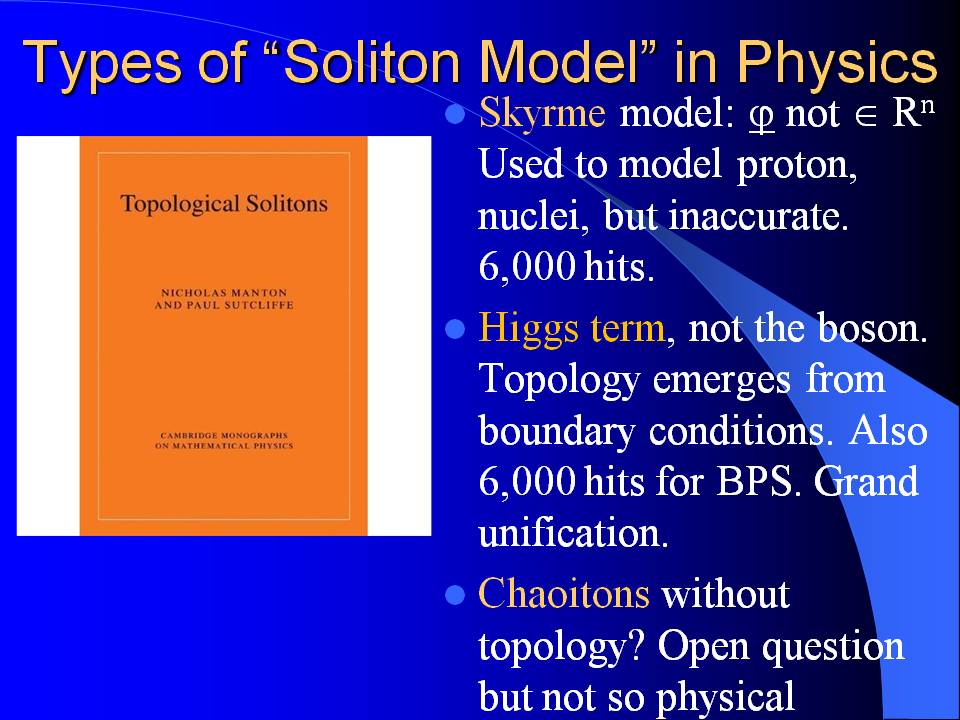
As the slide illustrates... there are three kinds of “soliton” model of interest in physics. Three ways of trying to describe or explain elementary particles as whirlpools of force. Mathematicians do not like to call these whirlpools “solitons,” because they have their own definition of the word “soliton,” different from what physicists use. So I said: “Hey, we agree that a sea horse is not a horse. So a topological soliton or a chaoiton (chaotic soliton) does not have to be a soliton.”

Many years ago, I defined a new concept of “chaotic soliton” or “soliton” in papers in the journal Chaos, Solitons and Fractals. It was a very natural concept, like what a mathematician would expect here. A “chaoiton” could EITHER be a stable fixed pattern of forces concentrated in a small region of space, a pattern which goes off to zero far away from that region, or it could be a stable SET of patterns, oscillating between each other but still staying there and not just dissipating away.

But then I read the yellow book, MRS. MRS actually described TWO types of “topological solition,” the Skyrme model type and the “BPS” type. Both are a bit of a stretch for a mathematician. Both model an elementary particle as a kind of “knot” in space, a knot which simply cannot be unitied, because the knot connects the particle all the way to space infinitely far away from the particle itself. The force fields describing the particle include at least one field which does NOT go to zero far away from the particle.

MRS even included a “theorem,” the “Generalized Hobart-Derrick Theorem,” which argued that objects like chaoitons simply could not exist in ordinary models of physics without hard-wired topology. I looked at the two page “proof,” and did not believe it. I wondered whether  Rybakov or Sanyuk might have worked out more of the details in their original work in Russian, or at least more explanation of what they were talking about.

And so, I tried to get more information. I spoke to the guy whom I funded who had a subcontract to Dubna, and visited the place often. He tried hard to bring back lots of information, but he really had nothing to say on this. But then... here in the US, at a conference, I met Ludmilla Dolmatova... whom I later married, but who did return to Russia and France in the meantime. In that mean time, she visited the offices of Rybakov and Sanyuk at Moscow State University, and obtained what they had, and had some good conversations --   but it did not really change the picture on that “proof”. (Yes, this was a huge thread in my life... but... back to the book...)

Can chaoitons exist, and could they be a possible model of electrons or quarks?

I made contact somehow with Prof. Pego of the University of Maryland, whose work on... solitary waves?... was perhaps the closest in the world then to what I had done with chaoitons. He had a PhD student, Lev Wertheim, whom I knew from Adelphi Quaker Meeting, who was also an all-Soviet mathematics Olympiad winner. We all agreed on a possible thesis project for Lev: to try to prove or disprove the alleged “Generalized Hobart-Derrick Theorem.” He already had access to my papers and Pego’s, through the usual US systems, but he needed, above all, the two pages of MRS stating the alleged Theorem and proof.

I intended to give Lev just the two pages, but life was very complex for me at that time, and I wasn’t able to get the xerox in a timely way, so as Quaker meeting I handed Lev the book and said: “Lev, I apologize, but I have to ask that you xerox those two pages yourself, and then return the book. But before I do, I want you to promise, PLEASE do not try to read the rest of the book. It is like a Godel-Escher-Back painting. It will drive you crazy if you try to make sense of it.” He promised.

A few days later, I was informed that he had been hospitalized, and I was invited to visit his apartment where his suitemates would return my book to me. “What happened?” I asked. “Well, he seemed normal and alert and intelligent as always, when he returned from Meeting. But then he sat down in that chair, and started to look at that yellow book.  At first he looked at it, and then away, as if he was very torn about whether to open it. But then he did. He started paging through it... slowly at first... page by page... and his eyes started glazing over. And then... well... we had to call the mental hospital.” A few days after that, they reported that the mental hospital had decided he had to go back to Novosibirsk (Siberia) where his family was, and he never returned to physics after that.  What kind of music did he take up then? I do not know. I imagine mournful old Jewish songs on ... old type string instruments.

So... reader beware.

For the seminar, I displayed instead a newer book, by Nicholas Manton of Cambridge University, which I hope would not be so risky for mental health. I do not know how easy that book would be to understand, for a first time reader, since I already knew much of the stuff when I bought it, and I read quickly up to chapter 11, which had some very exciting advanced new stuff. (Also some stuff much scarier than mere thermonuclear devices, for those who understand.) Manton talks BOTH about the Skyrme model and about the family of models related to the famous BPS topological soliton. And he talks about EWT, which makes contact with real experiments and predictions much more than QCD does.

Manton may well be the most important thought leader in the Western world today on the Skyrme model, and on ways to use that model in real nuclear technology. He is mainly known for a huge cross-cutting consortium, which uses the Skyrme model to predict properties not just of proton and neutron but also of small nuclei. Predicting nuclei... is meat and potatoes for practical places like Dubna and Livermore. His consortium has done very large-scale computer simulations, all simulations of the Skyrme model in just three dimensions of space... which is a lot easier than computing with a theory like QCD which requires lots and lots of dimensions. But the accuracy is not so impressive. Errors on the level of 20% and 40% compare well enough with other phenomenological models, but they aren’t exactly correct. What’s more, even if we question the exact details of QCD, we do know very well from high-energy experiments that the proton and neutron are made up of smaller and harder elementary particles, called “partons.”. (Basically, these are scattering experiments, like what Rutherford used to show that the atom has a small nucleus. The word “parton” is a good search term to learn more about those experiments.) So the Skyrme model is useful, sort of, maybe, but we should be able to do better. The “quark” model is just one of many possible models of what partons are like.

After years of digesting MRS and other things... I now believe quite strongly that our best hope of understanding electrons and partons is to model them as the OTHER type of topological soliton, the “BPS” family. The Skyrme model has limited accuracy, and does not really model partons anyway. The mathematics is less rigorous than the BPS mathematics, and “less rigorous” really means “lots of stuff that may be dead wrong.” I now have a much better idea how to construct examples of chaoitons in simple, ordinary field theories... but I am not as motivated now to resolve that issue, because I don’t think they are as plausible as the BPS type of model. Above all, in real physics, we see a very amazing quantization of electrical charge, the exact same unit of charge for all kinds of particles and compound bodies. In principle, that quantization COULD be just an emergent outcome of field statistics... so maybe the electron could be a chaoiton after all... but for now it seems both easier and more promising to work with the BPS family, where the quantization of “charge” (the winding number of the knot in space) is strict and easy and natural.

The key to the BPS model is the inclusion of a term called the “Higgs term” or the “Higgs force,” which is similar in a way to the famous Higgs boson, but NOT EXACTLY THE SAME. The Higgs force is the one which does NOT go to zero even infinitely far away from the particle. The “knot in space” is the knot formed by the vectors of the Higgs field, considered in spheres surrounding the particle.

The BPS family of topological solitons, using Higgs terms and assuming Higgs fields, is very well known in physics. In addition to Manton’s book, there is a simpler review paper written by Erich Weinberg of Columbia University. The physicists assume they have proven “well enough to be sure” that all these Higgs type topological solitons are rock hard stable, just like the electron, but no, they haven’t, EXCEPT for the one specific case of the BPS example, which is the limiting case of a simple model in the case where the Higgs term actually goes to zero! (A mathematician at Harvard really proved stability for that case, I think, basically using special boundary conditions INSTEAD of a Higgs term.) Even if I think more like an engineer than a physicist these days.. even engineers often have higher standards of proof here. I can imagine how these “stable” solutions might actually collapse into a point, or diffuse away into nothingness, even without any change in the “winding number.” I am not convinced by the existing “proofs” that this would not happen for some of the Higgs types theories. I really wish a solid mathematician would get in here, and either PROVE what Weinberg says, or provide a counterexample, and give us some guidance about WHICH Higgs-field models actually work.

But none of that is all electron or a parton yet. **IF** we had a good Higgs-type model of the parton, we could use that for practical nuclear simulations, just what Mantyon has been doing, but hopefully a whole lot more accurate. I could imagine using such a model “tomorrow” to improve Livermore’s ability to predict what actually happens when a laser pulse hits a deuterium/tritium pellet target, a subject of immense importance in trying to develop a new safe energy technology here. (I hear that Livermore’s laser fusion work is funded based on its spinoff value in making nuclear weapons design easier and more reliable. I suppose the new model could be useful there as well.)

In fact, I do have two candidates for what that model might be, much better than the earlier candidates I played with in past years, published in various places. These two new models basically fix some problems I found when I studied the earlier models. (When I first learned about the BPS model itself, I had some hope for it; I had to fully understand WHY it is not a good enough model, even for grand unified theory, before I knew how to do better.) I have not published the new alternatives anywhere, in part because Luda has urged me not to do so until/unless a higher impact journal agrees to publish the details. I did include them in a paper I showed to Marlan Scully and a couple of other people, and I included one of them in the slides I showed at Memphis last week. A lot of very basic work is needed to work out what stable soliton solutions these two new models have, and what properties they predict for nucleons as combinations of such partons. (I have of course studied a lot of what is known about strong interactions as a filter here, EVEN THOUGH I still propose that we use EWT itself with changes only in the Higgs term and in the representation of what the key B and W fields couple to.) Of course, such work might point to a need for further upgrades or tweaks, before such models could actually do better in Livermore than what they already have. We could still simulate the new model in three dimensions, as with Skyrme model, but partons are a bit smaller than protons, and one would have to use multiscale modeling to make it as routine and easy as the present models. (It is still in three spatial dimensions, however, making it a whole lot easier than simulating QCD!)

--------

That all is the normal part. If I were in graduate school, I would happily see how this could be a worthwhile life’s work... but as someone retired and  close to 70, scheduled for cancer surgery next month, I just write it up and hope no one else will have to put in so much effort as I did to see how the pieces fit together.

A couple of quick notes. My old teacher, Julian Schwinger, had a different theory of what the partons are. I believe it is very important that we NOT have premature religious commitment to either his model or QCD at this early stage. Some Higgs-field models based on extending EWT would yield solitons more like quarks, and some more like Schwinger’s dyons, but it is too early to restrict our choices. The basic mathematics and tools need to be further developed, and we should start with the simplest models
(like the two I now have) which seem like they might work for now. Yes, we could insert many topological charges to fit QCD more precisely, but why? For now, two might work; it is easy enough to add more, if and when we have solid guidance on what kind of tweak is needed of that type, if it should be needed. (I doubt it.) Some Higgs type models of the parton (and electron) would also predict a rigid conservation of what physicists call “baryon number,” but others, like the Russian work described in chapter 11 of Manton’s book (probably held secret now in Russia) would not. My two versions probably would not. If not... as Manton describes, and many Russians attempt... then it may be possible to “burn down protons and neutrons themselves” for energy. Basically, that would allow construction of devices like thermonuclear weapons, but about a thousand times as powerful, potentially using any materials at all as fuel.  Manton observes that this would require a special kind of coherent radiation as a catalyst. My slides for Memphis describe an extension of the Glauber-Sudarshan coherence theory  (the basis for designing lasers) which would be applicable here. I am amused that one of the key Russian places working on this, according to Manton, is the Institute for Nuclear Energetics in Protvino, where Luda obtained her “first PhD.” But no, she did not work on that project. There is also some connection here to the lower-energy lower-frequency stuff which Schwinger worked with in the last years of his life, also pretty wild. See http://drpauljohn.blogspot.com/2016/02/korean-rocket-and-navy-lenr-illustrate.html  . But hey, that’s for the further future. Testing the new Lagrangians mathematically and aiming to assist Livermore type of work is all I would write about at all, if I were more confident about either my personal long-term survival or the long-term survival of key actrivities in the US.


=============
Final note: this whole post elaborates on some aspects of the first part of a 3-part presentation with 33 slides in all. Another slide elaborated on the various concepts and measurements of the radius of the electron -- after noting that the "radius" of a whirlpool can be defined and measured in a variety of ways, and noting how MRS discuss the different values for the radius of the proton, all valid, explainable by a topological soliton model.

The second part dealt with distribution functions in Fock-Hilbert space, basically explaining my paper at arxiv.org on my extension of the Galuber-Sudarshan methods to three and four dimensional space. Part of that is a theorem showing that the energy levels we get from simple computer simulations are close to identical to those predicted by canonical quantum field theory (and maybe exactly identical, depending on how we interpret the usual self-energy corrections, like what people use to predict the Lamb shift).

The third part dealt with more recent work, which is what my own thinking is drawn to more lately. I mentioned my joint paper with Ludmilla in the journal Quantum Information Processing, which came out just a few months ago. More people at Memphis also expressed interest in the third part, because it has a connection to their work in graph theory, stochastic graphs, and emergent behavior like sudden phase shifts (which they see as analogous to the sudden drop of an electron from a high energy level to a lower one in the atom). TBD. 


Sunday, March 6, 2016

Unthinkable things which might happen in North Korea and elsewhere

North Korea has put its missiles and nuclear capabilities on hair-trigger readiness, in reaction to the new UN sanctions.

The new stronger sanctions were based on a reasonable conclusion that present trends in North Korea are 'way too risky to neglect, and that we need to bite the bullet on what happens there. Nevertheless, when we bite a bullet... will we get badly hurt, as part of the price, and will we ever be free of the worst case?

We should not be intimidated by those people, but what happens if in fact the guy is as crazy as we think he might be and he actually does launch something as his internal situation gets worse and worse? (Or, on another level, what does he see of our vulnerability?)

It is good that the US is deploying more antimissile capabilities to the area, but if all we get is hit-to-kill over the ocean or over South Korea, will a lot of people die in South Korea itself in any case?

This reminds me of how we COULD have had affordable space-based boost phase intercept by now,
above all if sheer corruption had not blocked our development of low-cost mass access to space. It makes a big difference whether the interception occurs over South Korea or over the launch site (North Korea or at least close to North Korea). If a major part of North Korea becomes a sea of glass as a consequence of THEM launching a nuclear missile (soon or ten years from now), that is a whole lot different from a major part of South Korea being fried that way. The world would be rather shaken up if the US replied to a North Korea strike on South Korea by turning North Korea itself into a sea of glass; it would be a whole lot less unpleasant if North Korea did that itself as a direct result of its own nucs, with far less damage to South Korea. The difference between today's antimissile capabilities and boost phase intercept is really huge, when we get realistic about the kinds of dilemmas  we may be facing in the future,

Why don't we have this capability? I remember when Lockheed and others discussed this option at a meeting in the Marshall Institute, and I went back to the legislative director for Senator Specter (on the Senate Defense Appropriations Subcommittee at that time) to ask about it. "The reason we don't do it is very simple. Too much cost." The cost would be orders of magnitude less if we implemented
a design for reusable launch vehicles, initially developed by Boeing but refined by Ramon Chase of ANSER about ten years gao, backed up by lots of peer-reviewed publications in AIAA venues and elsewhere (including rigorously peer-reviewed NSF-funded work). The cost estimate of $200/pound-LEO (and near term availability) withstood very intense scrutiny... and with that... we could have gone ahead and had protection from the very, very serious problems emerging here and now (and not going away soon).  Not perfect protection, but enough to prevent the much more serious worst case possibilities in play more and more. A factor of ten reduction in the likely cost to humanity of such bad things, which would cost a whole lot more than the new RLV, which would have many other profitable civilian benefits as well, important to sustainability in the larger picture.

Makes me wonder: would anyone in South Korea be interested in developing the core launch capability which the US should have done many years ago, and did not because some folks wanted to use the NASA budget as a cash cow jobs program and wanted to keep the world from following up on really serious alternative technology? (I saw quite a bit in my personal presence.)

At one point, I was hoping that maybe Donald Trump might crack down on the kind of corporate welfare legalized corruption which has prevented the US from developing what it could have... what we lost when Senator Shelby asked for Admiral Steidel's head on a platter.. but this week, a Politico story said, roughly: "Since Trump says he will be the new Teddy Roosevelt, cracking down on legalized corruption... the debate asked him how. He said 'just abolish EPA and Department of Education.'" Oops!! That's not what would get us a new RLV or boost phase interception!! It's more like what Lindsay Graham said ... a choice of a firing squad, versus the other guy's poison... and a third guy's calm support of Cheney style stuff which risks World War by another direct path.

Best of luck. We really need it.


Thursday, February 25, 2016

IEEE Conference on Big Data From Health to Brains to Stars

IEEE Conference on Big Data From Health to Brains to Stars

IEEE is the world’s largest professional society in engineering, with more than 400,000 members all over the world. Most of its societies, like the Computational Intelligence Society (CIS), have a significant surplus of cash from their conferences, journals, and magazines. Last year, to “give back” some of this money to the community, CIS held a competition to fund ideas for summer schools or conferences. That is how they funded a “summer school” (a large workshop) last week on Big Data in Computational Intelligence: From  Basic Principles to Large-Scale Applications. The conference was mainly made up of seven 1.5-hour talks spaced over two days, illustrating the key role that big data and computational intelligence tools can play on areas from health care and environment to brains and stars. I gave the first of these, bringing together the big picture both on risks and opportunities and on the underlying mathematics. The organizer, Nian Zhang of the University of the District of Columbia, plans to post the talks on the web, and had important assistance from others in the community. The talks and speakers, coming from great distances, are described at:
http://www.udc.edu/winter_school/IEEE_Cis_winter_school.htm

Here I will not post my own slides (even though they were quite colorful and took a lot of work).

In fact – I apologize to you. UNLIKE most of my blog posts, this is NOT written to be understandable to anyone except me. These are just my notes to myself after the conference, and preparing for a seminar I will give in Memphis. I usually do not post my personal journal entries, but ... just once, it should do no harm, I hope.

=======================================================
=========================================================


The UDC conference last weekend and the coming Memphis challenge have both been very stimulating to my thoughts – enough to remind me what I have been missing since retirement, and to remind me it would have been better if I had always taken the time to write down the insights I get before I forget them. Robert Kozma’s talk at UDC was “from brain to stars,” and indeed the new thoughts out of my usual daily routine mainly come in those two areas.

But: a lot of it builds on previous hard thinking here at home (easier than at NSF as schedules and culture get more and more hectic), and on the challenge ahead. Bit by bit, I feel called to broaden my attitude on about three things (as noted on page 87 of X2015, which I wrote in “like the old days” yesterday, sitting in a comfortable wooden chair with cushions tilted back, in this study, with new age music – Mannheim Steamroller and Kitaro – playing in the background, through this computer): on brains/minds, to get past “point prototypes” and the early syncretism model, to a full-fledged appreciation of Jungian things from math to noosphere; from Z to richer structure of time tracks (evaluating data of course); and – more today in particular, related to seminar to be given at Memphis – richer understanding of emergent behavior of nonlinear dynamical systems.

To some extent, my core job at Memphis is just to present what I have already done. The challenge is to make it comprehensible. Yesterday and in bed this morning, I tried to do more, to deepen the understanding... but because of limited time, I need to just record the basics of the new stuff and the new questions (incomplete as it is) this morning, and then freeze it, and move on to preparing talk (and reading Yury’s thesis).

Luda this morning reminded me that I need to be very careful with HOW I define my terms for Memphis. For example, I can take time with definitions, so long as I use the right language. Functions, distributions and measures are OK, but I need to be careful not to use the word “field” in a way which conjures up terror. But there is the advantage that I can say “look at this small special case” and not worry about people noticing I have included the whole universe and a highly multidimensional continuum of its relatives.  Are PDE dynamical systems? Sometimes yes, sometimes no. Dynamical systems are allowed objects, and I guess even definable. In fact, I do need to review a lot of ODE (and/or Prigogine space) objects to put it into context anyway, from Mehta to Boltzmann like.

But in the green notebook yesterday... there were ideas I also need to get down on computer, for two reasons: (1) to consolidate the logic a bit; and (2) to make it readable by me, with the major issue of eyestrain now permanent after cataract surgery. (A big ugly red hemmorage removed any doubt that I must be careful now as long as I live!)

My initial goal (when I sent abstract for seminar to Robert) was to explain the new generalized Boltzmann distribution (in a couple of forms) given in my “extended Glauber-Sudarshan” paper in arxiv. presented in 2014 in Scully’s workshop.
In practice, the consequences are almost the same as those reported in my much older cond-mat paper: for continuous states S(t) a probability Pr(S(t)) which is just f(E, C1, ... Cm)dS(t), where f is some function of energy and of the m conserved quantities of the theory. (m=0 is an allowed possibility, but the approach breaks down when there is no conserved energy.) This differs from the old idea that “the universe must go to a disorderly heat bath” (which Harold Szu reiterated at UDC, referring to a debate between Boltzmann and Poincare) because in the PDE case the derivative terms in the energy function do insert some connection/correlation between neighboring points, at infinitesimal separation. Still, that seems to suggest, on the surface, that the emerging order (pdf not well-approximated by the independence assumption across points in space) is mainly at a small scale.

Yet... I feel called to try to stretch further and be more open. So when I read Modesitt’s new novel, The Solar Express, I did take notice of his discussion of systems where there may be more pattern/regularity/order at LARGER distances than at smaller ones. (And of course for years and years I have remembered a paper by Wheeler, where he talks about neutrino temperature and tweaks things to account for the glaring fact that there are these objects called planets and stars, rather fundamental to what we see.) How does that work? Can that kind of patterning be understood/explained within the confines of first-order Hamiltonian systems, using the energy term f and not the invariant measure dS as a source of rich emergent behavior? Precisely how do open systems change things – remembering that there is such a thing as classical chaos in conservative systems (was that chaotic three-arm broom balancer due to Poincare?...)... and that the universe as a whole is presumed to be a closed system? (e.g. If chaos can occur in Hamiltonian systems, why not fractal patterns?)

First observation: I have ALREADY looked into emergent order, without naming it as such! The Boltzmann distribution is a function of conserved charges Ck, as well as E. It is precisely one of those conserved charges, the topological charge(s), which leads to that very important example of patterning or order, the topological soliton – i.e. the true elementary particles, the very foundation of everything we see on earth! Even more interesting... albeit just at vixra and my follow-on internal journal entry... “local minima” in the classical energy function also lie behind the various metastable states of atoms, as was worked out in some detail there! So YES, the Boltzmann term can do it, can generate “macroscopic” order on distance scales as huge as the Angstrom unit, so many orders of magnitude larger than the femtosecond scale we start with for the elementary particles. Two quantum jumps to greater distance already, just based on f(E,C1,...Cm)! Beyond that, what comes next are solid objects, things I know well from quantum electronics and photonics, and they certainly have interesting Boltzmann-based patterning varieties. I remembered Roger Lake... how the same topological soliton kind of pattern distribution can be elevated to the ordinary laboratory level... and the quantum separator (QS) at that scale. (Not to mention some of Von Neumann’s ideas about life.) So already with closed PDE systems (DO I SAY “CLOSED” OR “CONSERVATIVE” AT MEMPHIS???)... the energy term DOES allow all kinds of neat stuff. This week, I seem to be supporting Poincare as much as Von Neumann... maybe I need to look him up more... later...  (though for Memphis, it might help to show links...)

Now of course, the patterning we see with life on the surface of the earth (and the neuron example in the Solar Express,,, which I probably should WRITE DOWN when next I visit Central Library)... is due more to the injection of forwards time free energy, light from the sun. But what specific kinds of boundary conditions count as “forwards time free energy”? It is embarrassing how elusive it is to try to pin that down. In a way, we may not really NEED to formalize the GENERAL idea; we need Pr- and Pr+ boundary conditions at final and initial times, and that’s enough; more may not even be inherently well-defined, as it is ultimately just a rough way to characterize emergent statistics and specific local experiments/systems. But if we can see something more clear and more universal, it could be nice...

As I think more about that... I am intrigued by the possibility of getting more concrete (more specific, useful) results form a couple of special cases of “open” systems, which I think of as the “uniform light” and “cosmic ecology” examples/cases/paradigms. In the “light” example, we still have PDE, which can be represented by spatially uniform additional terms violating time-symmetry and/or energy conservation. (Now that I think of it... we have not proven that uniformity in 3D space would work... a vast ocean of light model ... in generating life as well as our local light does, entering in 2D. So many issues to explore!) Can we get nice equations for that? The cosmic ecology would start more concretely... considering things like rates of stuff ejected from black holes, gross recycling of stuff keeping the universe alive, described as close to ODE as possible... trying to keep it as simple as possible but real. (That reminds me of very important new supernova results from Kozma/Chile, which we will pursue after Memphis and after a brain exercise if all goes well.)

Thinking about the “light” example... it is striking how my previous results (in “Extended..”) really did rely on energy conservation. Yet shouldn’t the concept of equilibrium probability be expressable in a USEFUL closed-form way for density operators in the general case? In my mind... I think of how the basic Hamiltonian dynamics translate into dynamics for rho, with an obvious equilibrium condition. But isn’t that condition in the GENERAL case (e.g. including light systems) about as useless as Wiener’s nonlinear statistics, and in fact quite similar? It reminds me of the inherent problems in reification, and the inherent stuff in Arnold and in chaos.

So: for later. Something probably is there... some ordering... but not this week.

============================ brainy stuff:

Perhaps I should also type some of my thoughts about brain/mind/NN which came during UDC. Much fuzzier, and not part of an active goal beyond my own mind... but... whatever.

I was disappointed, of course, that Polikar – who seemed on course to solidify and upgrade syncretism, to address the crucial issue of real-time learning in brains – has drifted away into drifting away. A lot of the questions his new community are asking about nonstationarity are no more puzzling than causality, and perhaps I should have written some of it down earlier. (I have always had too much stuff to be able to publish so much as half of it.) Yet he has some stimulating questions, if the right questions are pulled out and played with.

For example: he asked (with some reification here): “What if we have two sets of variables, Y(t) and X(t), called labels and data? What if we have some initial data on Y(t) and X(t), and then a WHOLE LOT more data on X(t) later, especially in a world where relationships may change?” I urged consideration of two examples, an “auto” example and a linear example. In the auto example... Ford might have millions of data points on Y(t) and X(t) from thousands of engines or batteries, fully instrumented in the lab, followed by later getting billions of data points just from X(t) from cars on the road. (Hypothetical, assume wireless “phone home.”) The obvious approach is to learn just from the laboratory data, but also learn soft sensing to predict Y(t) from history of X(t) for use on the road. (Feldkamp and Prokhorov have an important soft sensing paper in Narendra, which I even repost on my own www.werbos.com/Mind.htm.) Later X(t) doesn’t do much! HOWEVER: in principle, one could use X(t) (predicting X(t+1) from X(<=t)) to find proper “hidden nodes,” preferred encoding, which one could then go back and use to REMODEL the laboratory data. ALSO: observing the range of variation of the later data, IF it is larger in some dimensions than the laboratory data, one can use it to put special weight on trying to get accurate measurement of weights which will explain more of the variance in later observations, a possibility for value weighting. (Still, a concept much trickier than Vapnik understands.) The linear example reminds us... if covariance of X to X changes, why not X to Y.... which rather grossly invalidates that kind of exercise.

-

I worked hard, in preparing my own talk (recorded by UDC, to be posted), to try to avoid being as depressing as I have been lately at home. Probably death of the entire species really is depressing, more so than my cancer, which still bugs me as well. I did not mention climate change hardly at all. But Diego, the final speaker on the first day, got into great detail on the kinds of stratospheric ozone effects which, after H2S upwelling from oceans, seem likely to get worse enough and be the first thing directly fatal to human life from climate as such. He also did a lot of mixture of experts modeling, though he did not remind us of what is or is not known about that general power of such things. Is there any such? I remain skeptical, and skeptical of its relevance to brains. Yet I must admit... that Jungian archetypes are beyond the point prototypes of classical syncretism, and that mixture of models thinking might be adaptable to that general case in a reasonable way, for noospheres if not for mammal brains. Worth thinking about, along with dynamics and drift of prototypes in general.

The final talk by Kozma included example of a solar surface model by Catalina Terra. (Met her to be sure!) Amusing what degree of parallel with Modesitt’s story... different desert, but still...

Wunsch objected to use of PSO to optimize, a comment I certainly found friendly. For general power, we need to get past methods like PSO which do not offer a good ratio of parameters-handled to number of examples explored... yes, use derivative and hence the chain rule for ordered derivatives... but when a dozen or two free parameters can do the job, priority in becoming more scientific involves two different upgrades, as I said to people: (1) technical aspects, related to what they are modeling now; and (2) new questions, the most important.

Re (1) :”Did you train and test?” It is remarkable that one PDE type model (even if with nonlocal field effects) could start form the beginning and track the long history of light emission from any star without new data coming in. (Or did it? Train and test needed.) I have seen cases in chemical engineering (my papers with McAvoy) where such was possible, but others in economics (my 1977/8 SMC paper predicting conflict in Latin America) where it was not, because of something... a general form... of “phase drift,” shown in my slides for UDC. UNLIKE the “nonstationarity” community... we have a compromise method which can address this kind of thing...  one more thing which needs to be translated even now... and a fundamental thing at that! (Some of the other things Polikar talked about can be modelled simply as hidden variables in time-series model, no fundamental significance at all, except insofar as some parameter values need to be thought about...
part of the universal vector intelligence game). Even now, I guess I need to be even more brutally explicit to the world in explaining/defining the basic mathematical concept of vector intelligence.

========================

From UDC, other loose ends... tell Lily about MomLink, Maia about Harold’s earthquake model (communicated and translated better) and Wunsch’s effort to use ADP on iterated prisoner’s dilemma (and his hypothesis about decomposing some types of games into “easy” and “PD-like”.) And Chawla’s health systems... maybe even related to my health! Luis for political cooperation? Whatever... if time allows.. I did look up Gulen, and need to explore loose ends in that area.

Anti-aging also came up, at UDC and in Solar Express, at many levels, from structures to people to ,... well, I always think about noospheres too. It too relates to the Boltzmann world, but has to be managed carefully in the weird environment we are in today.